Obviously Skincare
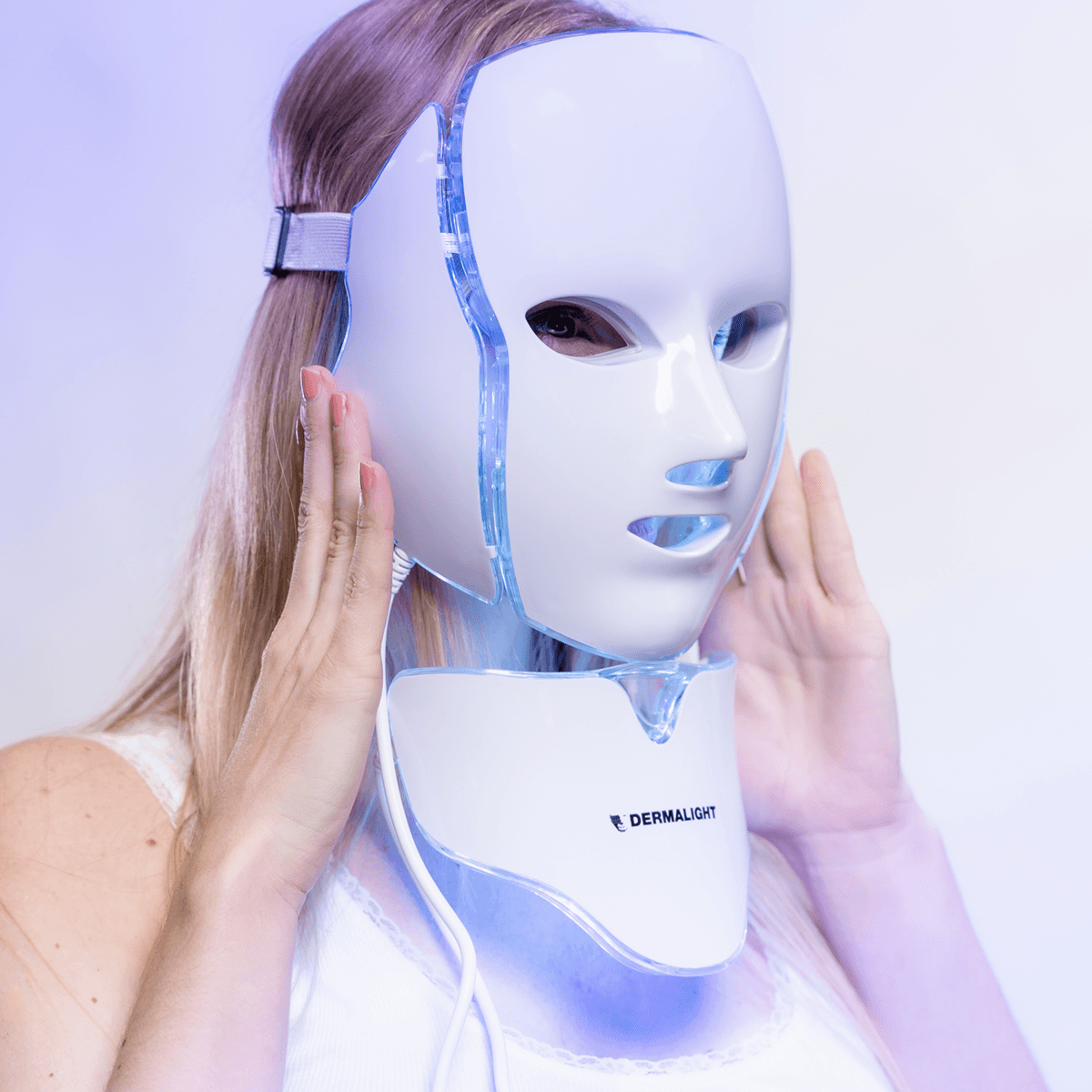
LED face masks shine coloured light onto the skin, most often red for anti-ageing and blue for acne. The science behind them is real, and some clinic-strength treatments have reasonable evidence. Home masks are weaker, the research on them is limited, and the results, where they appear, are modest. They're safe for most people if used as directed, but they're not a substitute for proven skincare.
Quick verdict
| Light | Claimed for | Evidence | Verdict |
|---|---|---|---|
| Red (around 630 to 660 nm) | Fine lines, skin texture, collagen | Moderate, mostly from clinic devices | Modest improvements possible with regular use |
| Near-infrared (around 830 nm) | Collagen, healing, inflammation | Limited to moderate | Often combined with red |
| Blue (around 415 nm) | Acne | Weak; a systematic review found no significant reduction in spot counts | Not a reliable acne treatment alone |
| Amber or yellow | Redness, soothing | Limited | Unproven |
| Green | Pigmentation | Very limited | Unproven |
How LED light therapy works
LEDs (light-emitting diodes) give off light at specific wavelengths. Unlike UV light or lasers, LED light at these levels doesn't burn or damage skin. Instead, it's absorbed by molecules in skin cells, a process called photobiomodulation.
- Red and near-infrared light are absorbed by mitochondria, the energy-producing parts of cells. This is thought to boost cell energy, encourage collagen production and calm inflammation.
- Blue light reacts with porphyrins, natural compounds made by acne bacteria (Cutibacterium acnes), producing molecules that damage the bacteria.
Longer wavelengths reach deeper into the skin. Blue light stays near the surface; red and near-infrared go further.
Free toolCan I use these together?Check whether two ingredients can be used together.Open the ingredient pair checker →What the evidence shows
Red light for wrinkles and skin quality
The best-known trial randomly assigned 136 volunteers to red or broad-spectrum light treatments twice a week for 30 sessions, or to no treatment. The light-treated groups had significantly improved skin complexion, smoother skin and higher collagen density on ultrasound, confirmed by blinded assessment of photographs. Broad-spectrum light did no better than red light alone.
More recent trials of home devices, such as a sham-controlled study of an LED neck device, have found improvements in wrinkle scores after 8 to 16 weeks, as judged by investigators, though participants themselves didn't always notice the difference.
Blue light for acne
The evidence is weaker than marketing suggests. A 2019 systematic review of 14 trials with 698 people found most were small, short and at high risk of bias. Some reported overall improvement, but there was no significant reduction in the number of inflamed spots, blackheads or whiteheads compared with no light. Side effects were mild.
Blue light is sometimes combined with red light, or used with a light-sensitising cream in clinics (photodynamic therapy), which is a different, stronger treatment.
Are home LED masks worth it?
| Home LED mask | Clinic LED | |
|---|---|---|
| Power | Lower | Higher |
| Sessions | Daily or several times a week, 10 to 20 minutes | Usually once or twice a week |
| Evidence | Limited, often manufacturer-funded | More, though still modest |
| Cost | Often £100 to £400+ upfront | Per session, adds up over a course |
| Convenience | High | Low |
Our take: if you've already got the basics right (daily SPF, a retinoid, a good moisturiser), have the budget, and enjoy using it consistently, a reputable red-light mask may give modest extra improvement in skin texture over months. If you're choosing between an LED mask and a retinoid plus sunscreen, the retinoid and sunscreen will do much more for much less.
For acne, proven treatments like benzoyl peroxide, adapalene and azelaic acid are far more effective. See the minimal acne routine.
Related guideExosomes in Skincare: What They Are and Whether They WorkExosomes are tiny messenger particles released by cells, now sold in serums and clinic treatments. What the research shows, the UK rules, and what to ask.Read the guide →Safety
LED masks are low-risk for most people, but:
- Protect your eyes. Use the goggles or eye shields supplied, and don't look into the lights. One major brand withdrew its acne mask from sale in 2019 over potential eye risks for people with certain eye conditions or taking light-sensitising medicines.
- Check your medicines. Some antibiotics (such as doxycycline), isotretinoin, some diuretics and other drugs increase light sensitivity. Ask a pharmacist.
- Avoid if you have epilepsy triggered by light, an eye condition, a light-sensitive skin condition such as lupus, or a history of skin cancer, unless a doctor agrees.
- Pregnancy: there's little safety data; many brands advise avoiding use.
- Follow the time limits. More isn't better.
- Stop if you get redness, burning, headaches or eye discomfort.
Choosing a mask
| Look for | Why |
|---|---|
| Stated wavelengths (e.g. 633 nm red, 830 nm near-infrared) | Shows it matches the research |
| Stated power or irradiance | Very weak devices are less likely to work |
| Medical device registration or safety certification | A sign of quality and safety testing |
| Eye protection included | Essential |
| A good fit | Light needs to be close to the skin |
| A returns period | Results take weeks to judge |
Be cautious of masks that promise to fix everything with many colours, very cheap devices with no specifications, and before-and-after photos without independent studies.
How to use an LED mask
- Cleanse and dry your skin. Remove makeup and sunscreen, which can block light.
- Put on eye protection.
- Use the mask for the time stated, usually 10 to 20 minutes.
- Continue your usual routine afterwards. LED is compatible with most skincare.
- Be consistent: most studies used two to five sessions a week for 8 to 12 weeks.
- Take photos in the same light every few weeks to judge honestly.
LED masks and other skincare
| Product | Together? |
|---|---|
| Retinoids | Yes. Many people use LED in the evening before a retinoid, but stop if irritated. |
| Vitamin C, niacinamide, hyaluronic acid | Yes |
| Exfoliating acids | Yes, but avoid immediately after a strong peel |
| Light-sensitising medicines | Check with a pharmacist first |
References
- Wunsch A, Matuschka K. A controlled trial to determine the efficacy of red and near-infrared light treatment in patient satisfaction, reduction of fine lines, wrinkles, skin roughness, and intradermal collagen density increase. Photomed Laser Surg. 2014;32(2):93-100. (https://pubmed.ncbi.nlm.nih.gov/24286286/)
- Scott AM, Stehlik P, Clark J, et al. Blue-Light Therapy for Acne Vulgaris: A Systematic Review and Meta-Analysis. Ann Fam Med. 2019;17(6):545-553. (https://pubmed.ncbi.nlm.nih.gov/31712293/)
- Park SO, Jang J, Park SH, et al. Efficacy and Safety of a Home-Use Light-Emitting Diode Neck Device for Improvement in Neck Wrinkles: A Multicenter, Randomized, Double-Blind, Sham Device, Superiority Verification, Confirmatory Clinical Trial. J Cosmet Dermatol. 2025;24(1):e16599. (https://pubmed.ncbi.nlm.nih.gov/39319750/)
- Guo Z, Yuan K. The Application of Light Emitting Diode (LED) in Cosmetic Dermatology. Photodermatol Photoimmunol Photomed. 2025;41(5):e70041. (https://pubmed.ncbi.nlm.nih.gov/40751922/)
FAQs
Do LED face masks actually work?
Red light can modestly improve skin texture and collagen with regular use. Evidence for blue light on acne is weak.
Are LED face masks safe?
For most people, yes, with eye protection and if you're not taking light-sensitising medicines.
How often should I use an LED mask?
Follow the instructions, usually several times a week for 10 to 20 minutes, for at least 8 to 12 weeks.
Is an LED mask better than retinol?
Can LED masks help acne?
Blue light may help a little, but a systematic review found no significant reduction in spot counts. Proven acne treatments work better.
Can I use an LED mask every day?
Many are designed for daily use. More isn't better; stick to the recommended time.
Do LED masks cause skin cancer?
No. LED masks don't emit UV light.