Obviously Skincare
The best retinol serum is one that states its strength, suits your skin, and that you'll keep using. Brand matters far less than those three things. This guide explains how to judge a retinol product, then lists eight that are widely sold in the UK, grouped by who they suit.
How these were chosen: on their published ingredients and stated strengths. They haven't been tested side by side, and nobody has paid to be included. Formulas change, so check the label before you buy.
What to look for
1. A stated percentage
Retinol works across a range of strengths, and trials have typically used 0.1% to 0.4%. A product that tells you its percentage lets you start low and move up. Many products don't, and some percentages on labels refer to a retinol-containing complex, not to pure retinol.
| Strength | Who it's for |
|---|---|
| 0.1% to 0.3% | Beginners; sensitive skin |
| 0.5% | After three months or more on a lower strength |
| 1% | Experienced users with resilient skin |
2. The type of retinoid
- Retinol: the standard. Converted in two steps to the active form.
- Retinal (retinaldehyde): one step from the active form. Works at lower percentages.
- Retinyl esters (retinyl palmitate, retinyl propionate): gentler and weaker.
- Granactive Retinoid (hydroxypinacolone retinoate): gentle; less evidence.
See retinol vs retinal.
3. Packaging
Retinol breaks down in light and air. Opaque, airless pumps and tubes protect it best. Clear jars are the worst.
4. What else is in it
Helpful additions: niacinamide, ceramides, squalane, peptides. Less helpful for sensitive skin: fragrance.
For beginners
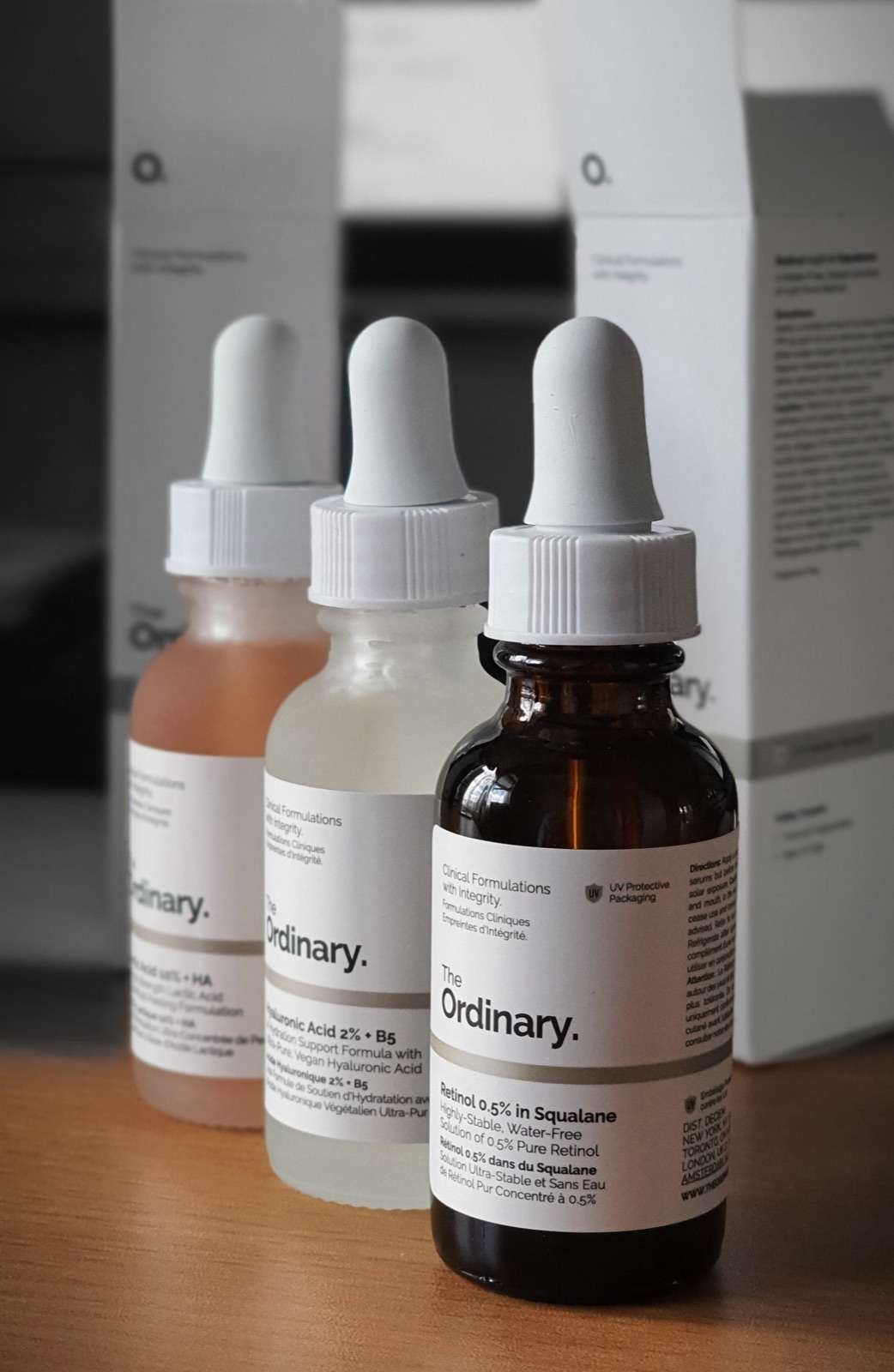
The Ordinary Retinol 0.2% in Squalane
Plain retinol at a stated, low strength in squalane, a light oil. No water, no fragrance. It's the cheapest way to start with a known dose, and the range continues at 0.5% and 1%, so you can step up without changing product. The oil base isn't to everyone's taste, and it needs storing carefully after opening. See The Ordinary Retinol 1% in Squalane for the top of that ladder.
The Inkey List Retinol Serum
A mild formula combining a stabilised retinol complex with Granactive Retinoid, in a base with squalane. The percentages on the label refer to the ingredient complexes; the amount of pure retinol is low. That makes it a very gentle introduction, and one you may outgrow. See the review.
CeraVe Resurfacing Retinol Serum
Encapsulated retinol with niacinamide and three ceramides, aimed at marks left by spots and uneven texture. It's fragrance-free and gentle. CeraVe doesn't state the retinol percentage for the UK product, so you can't place it on a strength ladder; treat it as a low-strength option.
Free toolRetinol starter scheduleGet a week-by-week plan for starting retinol.Open the retinol schedule →For sensitive or dry skin
Olay Regenerist Retinol24 Night Serum
A retinoid complex with niacinamide in a moisturising, fragrance-free base. The strength isn't disclosed. It's widely available in supermarkets and pharmacies, frequently discounted, and well regarded for being easy to tolerate.
La Roche-Posay Retinol B3 Serum
Stated at 0.3% retinol with vitamin B3 (niacinamide), and marketed for sensitive skin. One caution: it contains fragrance, which some sensitive skin won't like.
For stepping up
No7 Pure Retinol 0.3% Night Concentrate
A stated 0.3%, sold in Boots, with a 1% version to progress to. A straightforward high-street option with clear strengths.
Paula's Choice Clinical 1% Retinol Treatment
A stated 1% retinol with peptides and soothing ingredients, in a light lotion. For people who have used lower strengths comfortably for several months. Not a starting point.
Related guideBest Vitamin C Serums in the UK: How to Choose, and Eight to ConsiderHow to choose a vitamin C serum in the UK: pure L-ascorbic acid or a gentler derivative, what strength, and what to check on the label.Read the guide →For moving beyond retinol
Medik8 Crystal Retinal
Retinal, not retinol, in a ladder of strengths from 0.01% up to 0.2% and beyond, sold as Crystal Retinal 1, 3, 6, 10 and 20. Because retinal is closer to the active form, these percentages aren't comparable with retinol percentages. It costs considerably more than the others here. A good choice if retinol has plateaued for you and you don't want a prescription.
Quick comparison
| Product | Retinoid | Stated strength | Fragrance-free |
|---|---|---|---|
| The Ordinary Retinol in Squalane | Retinol | 0.2%, 0.5%, 1% | Yes |
| The Inkey List Retinol Serum | Retinol complex + Granactive | Complex percentages only | Yes |
| CeraVe Resurfacing Retinol Serum | Encapsulated retinol | Not stated | Yes |
| Olay Regenerist Retinol24 | Retinoid complex | Not stated | Yes |
| La Roche-Posay Retinol B3 | Retinol | 0.3% | No |
| No7 Pure Retinol Night Concentrate | Retinol | 0.3%, 1% | Check the label |
| Paula's Choice Clinical 1% Retinol | Retinol | 1% | Yes |
| Medik8 Crystal Retinal | Retinal | 0.01% to 0.2%+ | Check the label |
How to choose in one minute
- Never used retinol, normal skin: The Ordinary 0.2%, or No7 0.3%.
- Never used retinol, sensitive skin: Olay Retinol24, CeraVe, or The Inkey List.
- Blemish-prone, with marks: CeraVe.
- On a low strength for three months and comfortable: 0.5%, then 1%.
- Want more than retinol: retinal, or ask a GP about tretinoin. See retinol vs tretinoin.
- On a tight budget: The Ordinary.
Work out what each costs you per application with the cost per use calculator.
How to use whichever you buy
- Evening only, on dry skin.
- A pea-sized amount for the whole face.
- Two nights a week to start, building up over two to three months.
- Moisturise afterwards, or before and after. See the retinol sandwich method.
- SPF 30 or higher every morning.
- No exfoliating acids on the same night. See what not to mix with retinol.
The retinol starter schedule gives a week-by-week plan. Expect visible results at around 12 weeks; see how long retinol takes to work.
Don't use retinol if you're pregnant or trying to conceive. See pregnancy-safe skincare.
Do expensive retinol serums work better?
Not reliably. Price buys texture, packaging and sometimes better stabilisation. It doesn't buy a different molecule. A stated-strength budget retinol, used consistently with sunscreen, outperforms an expensive one used occasionally.
References
Kong R, Cui Y, Fisher GJ, et al. A comparative study of the effects of retinol and retinoic acid on histological, molecular, and clinical properties of human skin. J Cosmet Dermatol. 2016;15(1):49-57. (https://pubmed.ncbi.nlm.nih.gov/26578346/)
Randhawa M, Rossetti D, Leyden JJ, Fantasia J, et al. One-year topical stabilized retinol treatment improves photodamaged skin in a double-blind, vehicle-controlled trial. J Drugs Dermatol. 2015;14(3):271-280. (https://pubmed.ncbi.nlm.nih.gov/25738849/)
FAQs
What is the best retinol serum in the UK?
There isn't one for everyone. For a beginner on a budget, a stated low-strength retinol such as The Ordinary 0.2% is a sound choice.
What strength of retinol should I start with?
0.1% to 0.3%.
Is The Ordinary retinol good?
It's plain retinol at a stated strength for a low price. The oil base and the need for careful storage are its drawbacks.
Which retinol is best for sensitive skin?
A low-strength, fragrance-free formula with niacinamide or ceramides, applied over moisturiser.
Is retinal better than retinol?
It acts faster and at lower percentages. It usually costs more.
Can I buy tretinoin over the counter in the UK?
No. It's prescription-only.