Obviously Skincare
Yes, your skin type can change. Genetics set your baseline, but age, hormones, the seasons, medication, where you live and even your skincare routine can shift your skin from oily to dry, or make it more sensitive. If a routine that used to work suddenly doesn't, your skin may have changed rather than the products.
The five skin types, briefly
| Type | How it feels by midday | Pores | Common issues |
|---|---|---|---|
| Oily | Shiny all over | Visible, especially on the nose and cheeks | Blackheads, breakouts |
| Dry | Tight, sometimes flaky | Small | Rough patches, fine lines look more obvious |
| Combination | Shiny T-zone, normal or dry cheeks | Visible in the T-zone | Breakouts in the T-zone, dryness elsewhere |
| Normal | Comfortable | Small to medium | Few |
| Sensitive (can overlap with any type) | Stings, flushes or itches easily | Any | Redness, reactions to products |
Not sure which you are now? Take our skin type quiz or read skin types explained.
Signs your skin type has changed
- Products that used to suit you now feel too heavy or too light.
- More shine than before, or tightness and flaking you didn't used to have.
- New breakouts in places you didn't get them, such as the jaw and chin.
- Stinging or redness from products that never bothered you.
- Your T-zone and cheeks behave differently from how they used to.
- Makeup wears differently: sliding off by lunchtime, or clinging to dry patches.
What causes skin to change
Age
Oil production rises through puberty under the influence of androgens and stays fairly stable through adulthood. In a classic study of sebum and age, oil output in men stayed largely unchanged until around 80. In women, it fell gradually after menopause. Many women who had oily or combination skin find it becomes normal or dry in their fifties.
Separately from oil, skin gets thinner with age, holds less water, repairs more slowly and becomes more easily irritated. So mature skin often feels drier even when oil production hasn't changed much.
Hormones
| Life stage | Common skin changes |
|---|---|
| Puberty | More oil, blackheads and spots |
| Menstrual cycle | Oilier and spottier in the days before a period |
| Pregnancy | Can be oilier or drier; melasma (patchy pigmentation) is common |
| Hormonal contraception | Some types improve acne, others can worsen it |
| Perimenopause and menopause | Drier, thinner, more sensitive skin as oestrogen falls; adult acne in some |
| Polycystic ovary syndrome (PCOS) | Oilier skin, acne along the jaw, excess hair |
See hormonal acne.
Seasons and climate
Cold air, wind and central heating dry skin out in winter. In one study, just six hours in a dry, heated indoor environment increased roughness, redness and water loss from the skin. Heat and humidity increase oil and sweat in summer. Moving to a different climate, or between a humid and dry country, can change your skin noticeably.
Medication and health
- Medicines that dry skin: retinoids, isotretinoin, some acne and blood pressure medicines, diuretics, statins.
- Medicines that can increase oil or acne: some contraceptives, steroids, testosterone, lithium.
- Health conditions: an underactive thyroid can make skin dry and rough; diabetes can make it drier and slower to heal; eczema, psoriasis and rosacea can all start in adulthood.
Your routine
Your routine can change how your skin behaves in a matter of weeks:
- Over-cleansing and harsh foaming cleansers strip oils, leaving skin tight, and some people's skin then looks shinier.
- Over-exfoliating damages the barrier, causing redness, stinging and small bumps. See over-exfoliating.
- Heavy products can trigger breakouts in skin that's actually normal.
This is how skin can end up oily and dehydrated at the same time: shiny, but tight and flaky underneath. See dry vs dehydrated skin.
Lifestyle
Stress, poor sleep and smoking all affect skin. Stress can worsen acne and sensitivity, poor sleep weakens the skin barrier, and smoking speeds up ageing and dryness. See how stress affects your skin and sleep and your skin.
How to reassess your skin type
The bare-face test:
- Wash with a gentle cleanser and pat dry.
- Apply nothing.
- Wait an hour, doing your normal activities indoors.
- Look in the mirror and notice how your skin feels.
| What you notice | Likely type |
|---|---|
| Shine across forehead, nose, cheeks and chin | Oily |
| Shine on forehead and nose only | Combination |
| Tight, possibly flaky, no shine | Dry |
| Comfortable, a little shine on the nose | Normal |
| Red, itchy or stinging | Sensitive, or a damaged barrier |
Do this twice, a few weeks apart, and in different seasons, because skin changes.
Related guideHow to Build a Skincare Routine for Your Skin TypeA simple morning and evening skincare routine for oily, dry, combination and normal skin: what each step does, the right order, and how to add actives without irritation.Read the guide →What to do when your skin changes
- Simplify first. Strip back to a gentle cleanser, moisturiser and SPF for two to four weeks, so you can see how your skin behaves without actives.
- Reassess. Use the bare-face test or the skin type quiz.
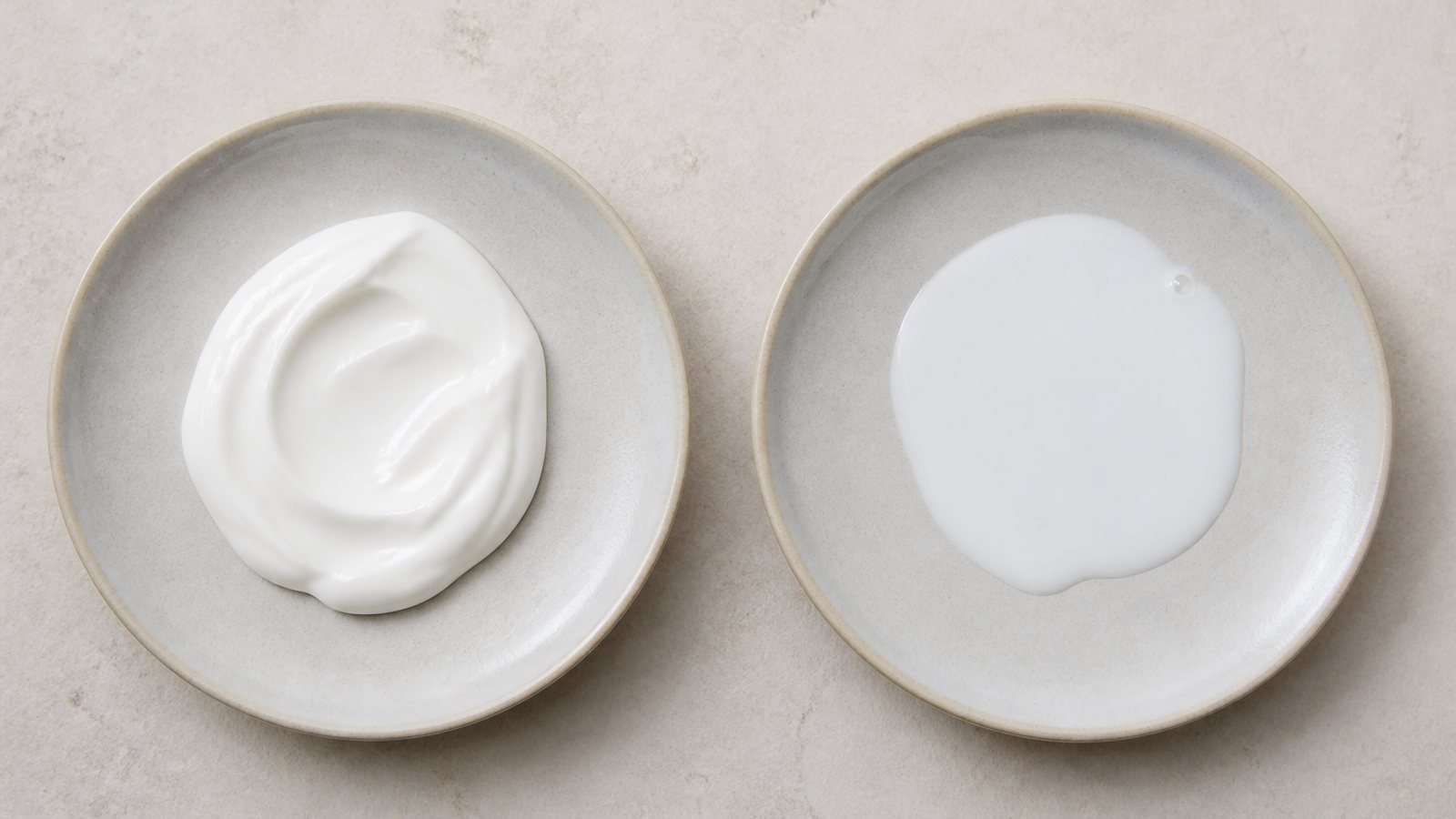
- Adjust textures with the seasons. A richer cream in winter, a lighter gel or lotion in summer. Many people keep two moisturisers.
- Reintroduce actives slowly, one at a time, two to three weeks apart.
- Rebuild your routine for your current skin. See how to build a skincare routine and skincare routines by age.
Quick adjustments by change
| Your skin has become... | Swap in | Cut back on |
|---|---|---|
| Drier | Cream cleanser, ceramide moisturiser, a hydrating serum | Foaming cleansers, strong acids, high-alcohol toners |
| Oilier | Gel cleanser, lighter moisturiser, salicylic acid, niacinamide | Heavy creams and oils |
| More sensitive | Fragrance-free basics, mineral SPF | Exfoliants, retinoids (temporarily), fragrance |
| Spottier | Salicylic acid, benzoyl peroxide or adapalene | Heavy occlusives on spot-prone areas |
When to see a GP
See a GP if your skin changes suddenly alongside other symptoms, such as tiredness, weight changes, feeling cold, hair loss or irregular periods, or if you develop a rash, persistent itching, or acne that doesn't respond to treatment within three months. These can have underlying causes, such as thyroid problems or PCOS, that are worth checking.
References
- Pochi PE, Strauss JS, Downing DT. Age-related changes in sebaceous gland activity. J Invest Dermatol. 1979;73(1):108-11. (https://pubmed.ncbi.nlm.nih.gov/448169/)
- Lephart ED, Naftolin F. Menopause and the Skin: Old Favorites and New Innovations in Cosmeceuticals for Estrogen-Deficient Skin. Dermatol Ther (Heidelb). 2021;11(1):53-69. (https://pubmed.ncbi.nlm.nih.gov/33242128/)
- Park EH, Jo DJ, Jeon HW, et al. Effects of winter indoor environment on the skin: Unveiling skin condition changes in Korea. Skin Res Technol. 2023;29(6):e13397. (https://pubmed.ncbi.nlm.nih.gov/37357654/)
- Oyetakin-White P, Suggs A, Koo B, et al. Does poor sleep quality affect skin ageing? Clin Exp Dermatol. 2015;40(1):17-22. (https://pubmed.ncbi.nlm.nih.gov/25266053/)
FAQs
Can oily skin become dry?
Yes. It commonly happens after menopause, with colder weather, with some medicines, or with harsh products.
Why has my skin suddenly become sensitive?
Often a damaged barrier from over-exfoliating or new products, but hormones, stress and weather can play a part too.
Does skin type change with age?
Yes. Skin usually becomes drier and thinner with age. In women, oil production falls after menopause.
Can your skin type change every season?
Your skin's behaviour often does: drier in winter, oilier in summer. Adjusting your moisturiser with the seasons is normal.
Can skin go from dry to oily?
Yes, for example during puberty, with hormonal changes, in hot humid climates, or with some medicines.
How often should I change my skincare routine?
Adjust it when your skin changes, and with the seasons if needed. Don't change everything at once.