
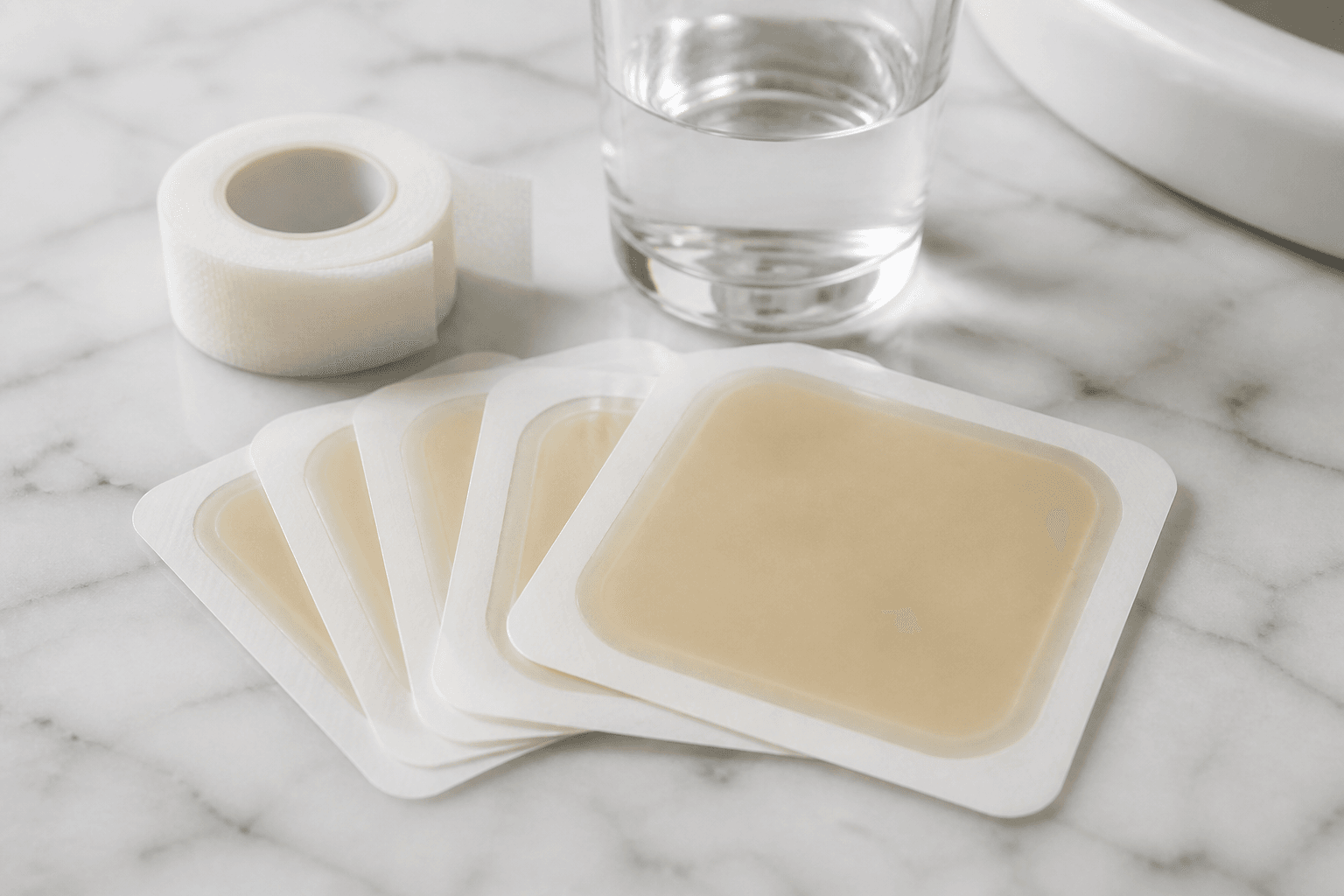
Hydrocolloid patches for pimples are the one spot treatment that looks like a sticker and behaves like a dressing. They do work. They just don't work on every spot, and they don't work the way a lot of short videos imply.
If you've ever peeled one off in the morning and found a cloudy white blob on the underside, that's the patch doing its job. If you've stuck one on a deep, angry lump with no head and woken up disappointed, that's the patch being asked to do a job it was never designed for.
What hydrocolloid actually is
Hydrocolloid is a gel dressing. Hospitals and pharmacists have used it for decades on blisters, shallow wounds and ulcers, because it absorbs fluid and keeps the area moist while it heals. The "colloid" bit means particles that hold onto water. On your face, those particles hold onto the watery gunk sitting in a pimple that has come to a head.
The patch is not medicine. There is no acid in the classic versions, no benzoyl peroxide, no tea tree. It is a thin, sticky, waterproof layer of absorbent gel with a film on top. That's why a cut-up blister plaster and a branded pimple patch are cousins. The branded ones are just cut smaller, thinner, and designed to stay on a face overnight.
Once it sticks, fluid is pulled into the gel so the pimple flattens, and your fingers can't get to it. For a lot of people, the second job is the more valuable one.
What they can do
Flatten a whitehead overnight. If there's a visible head and something to absorb, a patch will usually take the swelling down by morning. The spot is often still there, just smaller, less angry, and less likely to scab if you leave it alone.
Stop you picking. A physical barrier is more reliable than willpower at 11pm. That's why they're useful even when the absorption is modest.
Protect a spot you've already interfered with. If you popped it, a patch is damage control. It covers the open bit, soaks up leftover fluid, and stops you going back in for a second squeeze. Here's why popping makes it worse.
Keep makeup and pillowcases off the spot. The film is a lid. Dirt, foundation and cotton aren't being rubbed into an open pimple all night.
What they can't do
They can't reach a closed or cystic pimple. No head, no fluid at the surface, nothing for the gel to drink. A deep lump under the skin will still be a deep lump in the morning. Don't waste a patch on it, and don't keep stacking new ones hoping the third one "kicks in".
They don't kill acne bacteria or unclog the pore. That's salicylic acid and benzoyl peroxide territory. A hydrocolloid patch treats the puddle, not the plumbing.
They don't fade the mark afterwards. Once the spot is flat, the red or brown stain is a pigment problem. Patches do nothing for that.
They are not a routine. You don't need to sleep in patches every night "just in case". Use them on spots that have a job for them.
Overnight use is the point
Hydrocolloid needs hours, not twenty minutes before you leave the house. Most packs say six to eight hours. Overnight is the obvious window: you're not talking, eating, or rubbing your face, and the patch has time to fill.
Put it on clean, completely dry skin. No moisturiser, serum or spot cream underneath: anything damp or greasy stops it sticking, and a patch that lifts at the edges does nothing. Leave it until morning. If it's gone opaque white, it's full. Peel it off, don't scrape, and only replace it if the spot is still leaking.
Daytime is fine if you want the barrier; thinner "invisible" ones sit better under makeup. Absorption still needs hours. Practical steps are in how to use pimple patches.
Which ones to buy
You do not need a viral tin. You need hydrocolloid that sticks. In the UK that's COSRX at around £6 for 24, Dots for Spots at Superdrug for about the same, or Mighty Patch if you want a thicker overnight sticker. The round-up of best pimple patches in the UK is the shopping version of this page.
A blister plaster from the chemist works in a pinch if you cut it down. It will look worse and may peel sooner. That's a DIY problem, not a reason to skip the real ones.
The honest verdict
Hydrocolloid patches for pimples work on spots with something to absorb: whiteheads, pustules, and the mess after you've picked. They do not work on blind pimples, cysts, or blackheads sitting in an open pore. They are a dressing, not a treatment plan.
Use one overnight on the right spot, keep your hands off it, and put the rest of your energy into the products that actually prevent the next one.
I'm not a doctor. If spots are scarring, painful or covering half your face, that's a GP conversation, not a sticker one.
FAQs
Do hydrocolloid patches for pimples actually work?
Yes, on whiteheads and spots that have come to a head. They absorb fluid, flatten the bump and stop you touching it. They do not work on deep, closed or cystic pimples.
How long should I leave a hydrocolloid patch on?
Six to eight hours is the usual window, which is why overnight is the default. Take it off in the morning, or sooner if it's gone fully white and starting to lift.
Can I put a hydrocolloid patch on a pimple with no head?
You can, but it won't do much. There's nothing for the gel to absorb. Leave closed spots alone and use a proper treatment instead of a sticker.
Are hydrocolloid pimple patches the same as blister plasters?
Same family of dressing, different shape and stick. A cut-up blister plaster will absorb fluid. A face-sized patch is thinner and usually stays put better on cheeks and chin.
Do I need medicated pimple patches or plain hydrocolloid?
Plain hydrocolloid is enough for most whiteheads. Acid-infused versions are a bonus, not a requirement, and they still need a head to work on.