
People say Korean sunscreen is better. Usually they mean the texture. Some of that is true, and some of it is shopping. The protection story is more boring: a well-applied SPF50 from either tradition works, and a pea-sized smear from either tradition does not.
Here is what is actually different: how it feels, how UVA is labelled, which filters show up, and why American bottles lag behind both Korea and the EU. Product picks live in the UK roundup. This is the comparison.
Texture is the real split
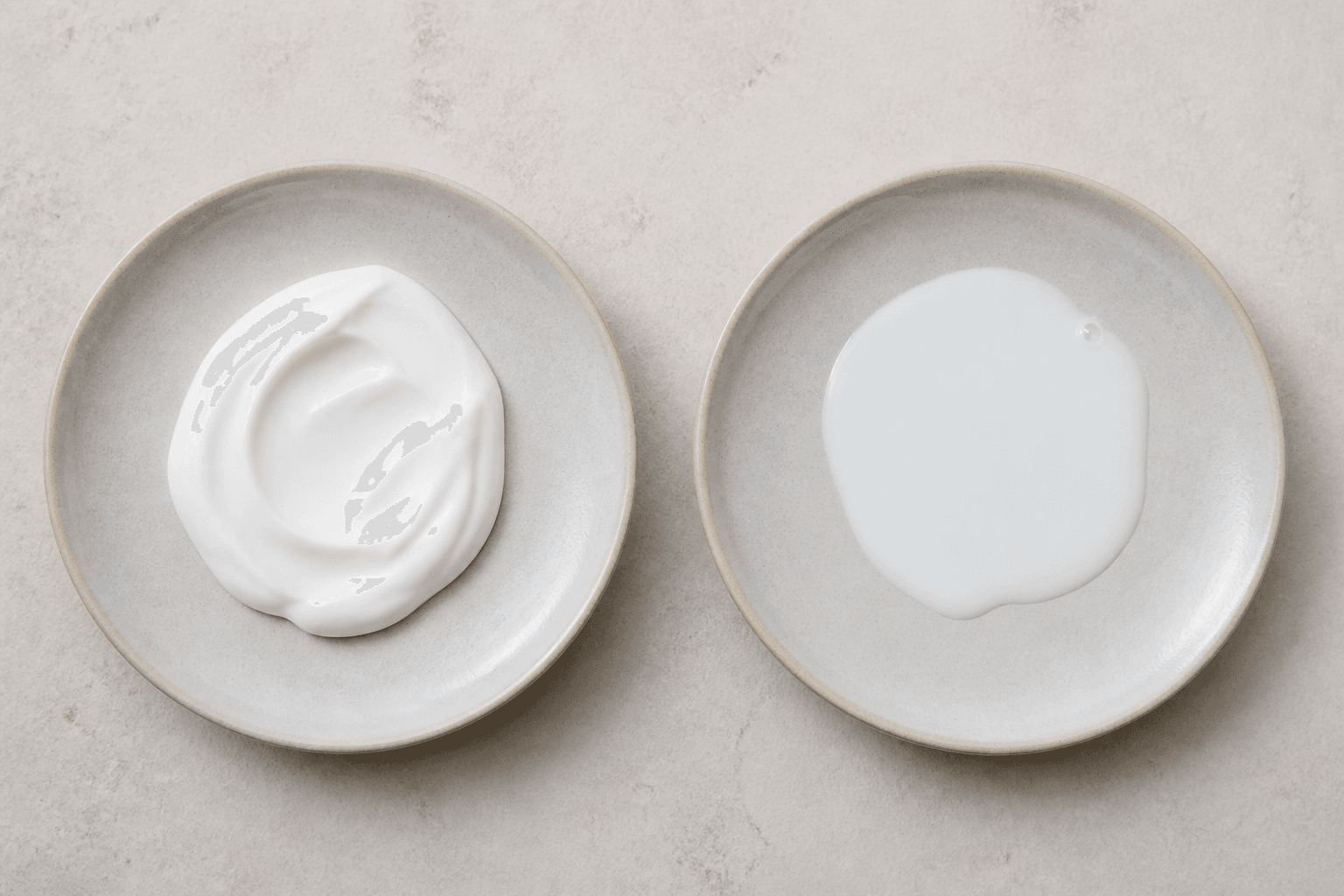
Korean SPF is formulated as daily skincare. Gels, serums, milks. Dewy default. You wear it to work. Beauty of Joseon feels like a moisturiser. Round Lab feels like a hydrating cream. Missha Soft Finish is the powdery exception.
Western SPF, especially older British high-street and American drugstore, was formulated as sun care: thicker, more water-resistant, more smell, more chalk if it is mineral. That is changing. French pharmacy fluids (La Roche-Posay, Bioderma, Avene, SVR) can be as elegant as anything from Seoul. "Western" is not one texture.
If you live in the UK, you are not stuck with a 2008 holiday bottle. You are choosing between a Korean serum and a Lyon fluid, not between Korea and "the West" as a blob.
People switch to K-SPF because the average tube they tried first was unpleasant. They stay if the new one is pleasant. That is compliance, which is how SPF actually works.
PA rating vs "broad spectrum"
Korea and Japan use PA+ to PA++++ for UVA. Four pluses is the ceiling on that scale. It is easy to shop by. It is why Stylevana filters exist.
The UK and EU use SPF plus a UVA mark (often the circle logo) that means UVA protection is at least a third of the SPF. "Broad spectrum" on US bottles is a different test again.
None of these systems let you skip reapplication. PA++++ is not a stronger magic than a good EU UVA circle. It is a clearer badge. If you want the badge, Korean (and some Japanese) labels are satisfying. If you already like an Anthelios fluid, you are not unprotected because it lacks pluses.
COSRX Aloe is PA+++, which still counts, and is a reminder not to treat four pluses as the only acceptable product.
Filters: US lag, EU/KR overlap
This is the bit that turns into internet fights.
The US treats many UV filters as over-the-counter drugs. Newer filters that have been used for years in Europe and Asia have been slow to get through that process. So a lot of American sunscreen still relies on older chemical filters and on zinc/titanium. That is a genuine formulation constraint. It is why US visitors go feral in a Seoul Olive Young.
The EU and UK allow a wider modern filter list. Korea does too, with its own rules, and a cosmetics-style market that pushes those filters into very light bases.
So: Korea versus America is a big gap. Korea versus France is a smaller gap. A UK shopper can buy both. You are not locked out of Tinosorb-type elegance if you refuse to import; you might just be paying LRP prices instead of Stylevana prices.
You do not need a chemistry lecture to shop. If you want the practical outcome — light, little white cast, PA++++ — Korean daily SPFs are an efficient search. If you want oil control that actually mattifies, a Western pharmacy fluid may still win: best SPF for oily skin versus Korean options for oily skin.
What Western SPF still does better
Mattifying oil control. K-beauty wants glow. Pharmacy brands will happily make you flat-matte.
Water resistance as default. Beach products are still a Western supermarket strength. Korean daily serums are not automatically swim SPFs. Missha Waterproof exists because the daily line is not enough.
High-street access. Boots will sell you LRP and, increasingly, COSRX. It will not reliably sell you Isntree.
Sensitive, fragrance-free, "dermo" branding. Some people want a short INCI and a pharmacy badge. Korean formulas often add rice, birch, probiotics, a scent. That is nice until it is not: Korean sunscreen for sensitive skin.
Stick sizes and kids' formulas on every corner. You can import, or you can buy Nivea.
What Korean SPF still does better
Wearability for daily face. That is the category.
Price for elegance. Cheap K-SPF at £12–£18 for a serum texture is a good deal against a £20–£30 fluid.
Dewy, makeup-friendly films when applied properly: under makeup, how to apply.
No-cast defaults on a wider range of skin tones.
Dry skin is usually happier in the Korean aisle: Korean sunscreen for dry skin.
How to choose without a tribe
Ask: will I wear this every morning? Then: can I buy it again easily? Then: do I need matte or moisture? Then: swimming or desk?
UK hybrid life is normal: Joseon on weekdays, a water-resistant European cream on holiday, powder for reapplication over makeup. Double cleanse whoever made the filters. Layer the same way.
This sits inside why Korean skincare is effective: prevention, hydration, SPF you do not hate. Other products: Korean skincare in the UK.
The verdict
Korean vs Western sunscreen is mostly texture, labelling, and which filters a market made easy. The US lags. The EU and Korea overlap more than social media admits. Buy the finish you will use. The better SPF is the one on your face at two fingers' worth.
FAQs
Is Korean sunscreen better than Western sunscreen?
Often nicer to wear. Not automatically higher protection. A good EU fluid matches a good K-SPF if you apply enough of either.
Why can't I get Korean-style filters in the US?
Many newer filters are stuck in a slow US drug-approval process. Europe and Korea have allowed them for years. The UK follows the EU-style list more than the US one.
What does PA++++ mean compared with broad spectrum?
PA++++ is a Korean/Japanese UVA grade. Broad spectrum is a different UVA test, common on US labels. Both are trying to tell you you have UVA cover. Neither replaces SPF or reapplication.
Should I switch if I already like La Roche-Posay?
No. Keep it. Switch if you hate the feel, the cast, or the price.
Are Korean sunscreens legal and safe to use in the UK?
Yes, as cosmetics imported and sold here through retailers. Buy from known shops, not mystery marketplace tubes.