
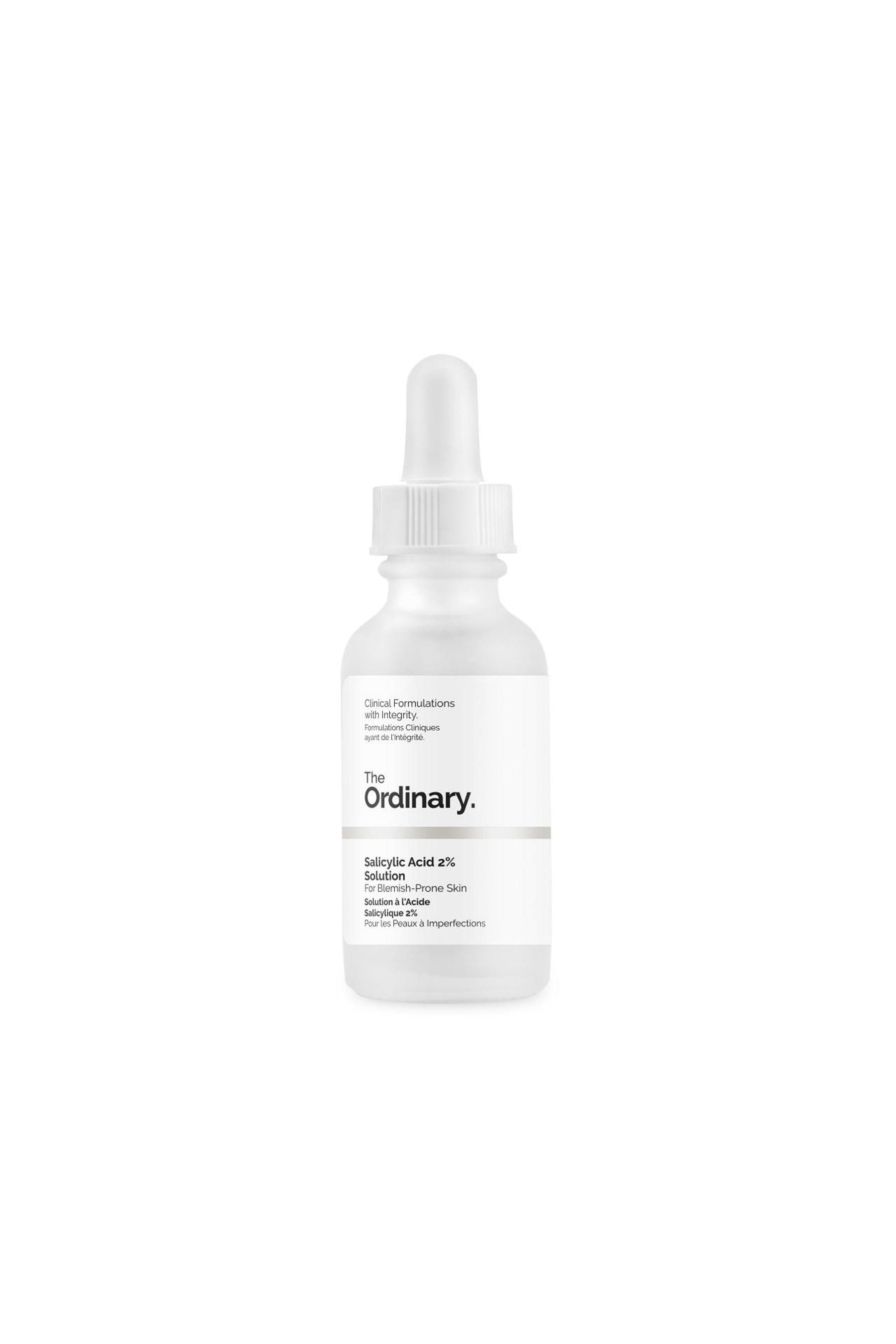
The Ordinary's Salicylic Acid 2% Solution was one of the first products I ever reviewed on this site, back in 2019. Since then, Deciem pulled the original formula, reworked it, and relaunched it as the Salicylic Acid 2% Anhydrous Solution. I've updated this review for the current formula, and the short version hasn't changed much: for the price, this is still one of the best blackhead and breakout treatments you can buy. The new anhydrous (water-free) base is squalane-heavy, which makes it noticeably gentler than the original ever was.
Here's the full review: what salicylic acid actually does, my 45 days of testing, how to use it properly, and who should give it a miss.
What is The Ordinary Salicylic Acid 2% Anhydrous Solution?
It's a leave-on chemical exfoliant containing 2% salicylic acid, the maximum strength allowed in over-the-counter cosmetics in the UK. The Ordinary's claim is that it exfoliates inside the pore to reduce blemishes and congestion, and unusually for a marketing claim, the science backs it up.
The reformulated version suspends the acid in squalane and oils rather than water, hence "anhydrous". In practice this means it feels more like a light, silky serum than the watery original, and the built-in emollients buffer some of the irritation that made the old formula sting. You can buy it directly from The Ordinary.
Why salicylic acid works where scrubs don't
Salicylic acid is a beta hydroxy acid (BHA), and in cosmetics BHA almost always means salicylic acid specifically. What sets it apart from the AHAs like glycolic and lactic acid is one crucial property: it's oil-soluble.
Water-soluble acids work on the surface of the skin. Salicylic acid dissolves into sebum, which means it can travel down into the pore itself and exfoliate the pore lining from the inside. That's exactly where blackheads form, when dead skin cells and oil compact together and oxidise, so a BHA reaches the problem in a way that no face scrub, pore strip or AHA can. I've written a full breakdown of the differences between AHAs and BHAs if you want the detail.
On top of the exfoliation, salicylic acid is related to aspirin and has genuine anti-inflammatory properties, which is why it calms angry red spots as well as clearing congestion. Research has also shown it helps regulate sebum production over time, which matters if an oily T-zone is the root of your problem.
My 45 days with it
For context, I have combination skin: dry-ish cheeks, an oily T-zone, and a long history of blackheads on and around my nose that no amount of cleansing ever fixed. This testing diary is from my original 2019 trial, with notes on how the new formula compares.
Day 1: expect a tingle
The original formula stung, genuinely. I applied too much, too widely, over dry patches near my mouth, and paid for it with irritated red skin for a couple of days. Entirely my own fault for skipping a patch test, which is why I now patch test everything and tell everyone else to as well.
The anhydrous reformulation is a different experience. There's a mild warmth on first application but nothing close to the old burn, and the squalane base means it doesn't parch dry areas the same way. Still patch test it. A 2% BHA is a proper active, not a moisturiser.
Week 1: visibly less congestion
By day three or four my T-zone was noticeably less oily by mid-afternoon, and the blackheads on my nose looked smaller and shallower. By the end of the first week the difference was obvious: fewer new spots forming, existing ones flattening faster, and skin texture smoother to the touch. My skin had also adjusted to the acid, so the initial sensitivity had mostly gone.
Day 45: the blackheads finally cleared
This is where salicylic acid earns its keep, because the results compound. After six weeks, the blackheads that had survived years of steaming, squeezing and pore strips were essentially gone. My pores looked visibly smaller, not because they'd shrunk (they can't), but because they were no longer stretched open by oxidised plugs of oil. Breakouts became rare rather than routine.
One product replaced an entire drawer of gimmicks, and years later a 2% BHA is still a permanent fixture in my routine. If large pores are your main concern, it pairs brilliantly with niacinamide; read my review of The Ordinary Niacinamide 10% + Zinc 1% for the other half of that combination.
How to use it
- Start with two or three evenings a week, not daily. Apply a few drops to clean, dry skin after cleansing and before moisturiser. You can build to nightly use once your skin tolerates it, though most people never need more than every other day.
- Patch test first. Inner forearm or behind the ear for a few days before it goes anywhere near your face.
- Wear SPF every morning. Chemical exfoliants increase sun sensitivity, and skipping sunscreen undoes the good work. SPF is non-negotiable with any acid in your routine.
- Don't stack it with other strong actives in the same session. Salicylic acid alongside retinoids or high-strength AHAs is a fast route to a wrecked barrier; here's the full list of ingredients you shouldn't mix.
- If you overdo it, stop. Stinging that doesn't settle, tightness and flaking are signs of over-exfoliation, not signs it's "working".
Who it suits, and who should avoid it
Best for: oily and combination skin, blackheads and congested pores, mild to moderate breakouts, and anyone whose spots tend to be clogged rather than cystic. If that's you, this product is close to essential; it's the backbone of The Ordinary's own blackhead regimen for a reason.
Approach with caution: very dry or sensitive skin, active eczema or a damaged barrier, and anyone already using prescription acne treatment (check with your prescriber first). Salicylic acid is also generally advised against during pregnancy in leave-on form, so speak to your GP or midwife. If you're sensitive but still want the benefits, an azelaic acid or a low-strength PHA is a gentler starting point.
How it compares to Paula's Choice 2% BHA Liquid
The obvious rival is the Paula's Choice Skin Perfecting 2% BHA Liquid Exfoliant, the cult favourite in this category. Same active, same 2% concentration. The Paula's Choice liquid has a more elegant, watery texture, is buffered to be gentle enough for many sensitive skins, and covers the whole face easily, but it costs several times more per bottle. The Ordinary's version is richer thanks to the squalane base, better as a targeted treatment for the T-zone or breakout-prone areas, and dramatically cheaper.
If money is no object and you want a full-face daily exfoliant, Paula's Choice edges it. If you want 90% of the results for a fraction of the price, The Ordinary wins, and it's what I keep repurchasing.
Verdict
This remains one of the best-value actives in skincare. The reformulation fixed the original's biggest flaw (the sting) without blunting the results.
Pros:
- Genuinely clears blackheads and congestion where scrubs and strips fail
- Reduces oiliness and the frequency of breakouts with consistent use
- New anhydrous formula is far gentler than the 2019 original
- Very affordable, and a little goes a long way
- Sinks in without greasiness despite the oil base
Cons:
- Still too strong for very sensitive or barrier-damaged skin
- Results take weeks, not days; impatience leads to overuse
- The oily texture won't suit everyone under makeup, so it's best used at night
- Requires diligent daily SPF
If blackheads and an oily T-zone are your battle, buy it, use it two or three nights a week, and give it six weeks. It's the product I'd hand to anyone starting a minimal routine for acne-prone skin.
References
Arif T. Salicylic acid as a peeling agent: a comprehensive review. Clin Cosmet Investig Dermatol. 2015;8:455-461. (https://www.ncbi.nlm.nih.gov/pmc/articles/PMC4554394/)
Zander E, Weisman S. Treatment of acne vulgaris with salicylic acid pads. Clin Ther. 1992;14(2):247-253.
Lu J, Cong T, Wen X, et al. Salicylic acid treats acne vulgaris by suppressing AMPK/SREBP1 pathway in sebocytes. Exp Dermatol. 2019;28(7):786-794.
Kornhauser A, Coelho SG, Hearing VJ. Applications of hydroxy acids: classification, mechanisms, and photoactivity. Clin Cosmet Investig Dermatol. 2010;3:135-142.
Frequently Asked Questions
Is The Ordinary Salicylic Acid 2% the same as the original formula?
No. The original water-based solution was discontinued and relaunched as the Salicylic Acid 2% Anhydrous Solution, which suspends the acid in squalane and emollient oils. The active and strength are identical, but the new version is noticeably gentler and less drying.
How often should I use The Ordinary Salicylic Acid 2%?
Start with two or three evenings a week on clean, dry skin, then build up as tolerated. Most people get full results at every-other-night use; daily application is rarely necessary and increases the risk of irritation.
Does salicylic acid get rid of blackheads?
Yes, and it's one of the few things that genuinely does. Because it's oil-soluble, salicylic acid exfoliates inside the pore where blackheads form, dissolving the plug of dead skin and oxidised sebum. Expect visible improvement within two to six weeks of consistent use.
Can I use salicylic acid with niacinamide?
Yes, they pair well. Salicylic acid clears the pore while niacinamide helps regulate sebum production, which tackles congestion from both ends. Use the salicylic acid first on dry skin, then apply niacinamide, or use one in the morning and one at night.
Do I need sunscreen when using salicylic acid?
Absolutely. Chemical exfoliants leave fresh skin more vulnerable to UV, so a broad-spectrum SPF 30 or higher every morning is essential, even if you only apply the acid at night.