
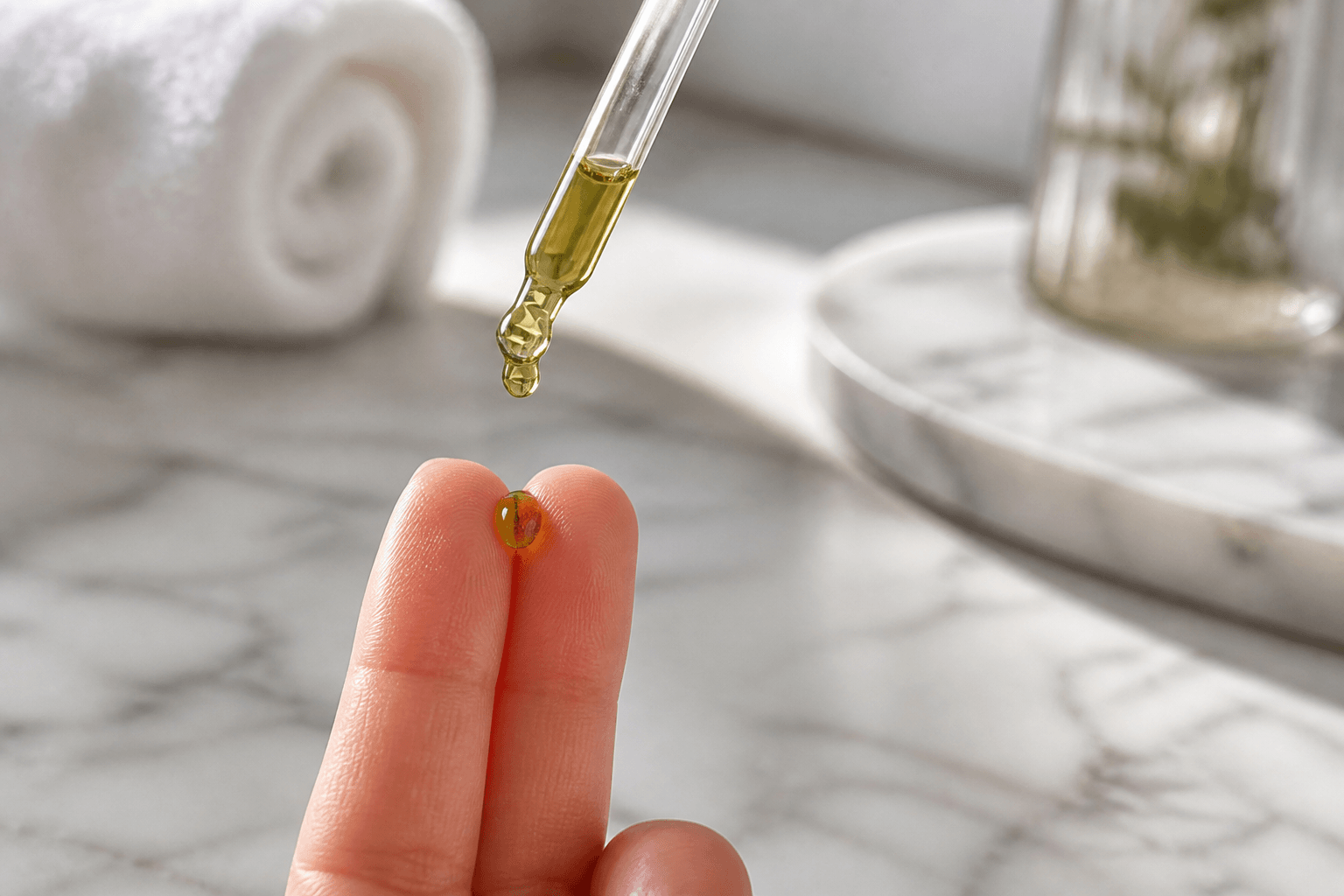
Bakuchiol is easier to place in a routine than retinol, which is half the appeal. You do not have to hide it in a night-only box, you usually don't need a six-week "ramp", and it sits in the same slot as any other leave-on treatment: after cleanse, before the heavy cream, thin to thick.
The mistakes are ordinary. Using three bakuchiol products at once. Skipping sunscreen because someone said it is photostable. Putting it on a wrecked barrier and deciding the ingredient "doesn't agree with you".
Where it goes
Serum or booster: after cleansing (and toner, if you use one), before moisturiser. A few drops for the face. Press, don't rub like you're polishing wood.
Oil booster (Bybi's 1% in squalane is the UK example): last, or mixed into moisturiser. Oil on top of water-based layers. If you put it under a watery serum it just sits there.
Moisturiser with bakuchiol already in it: that is the moisturiser step. You do not need a separate bakuchiol serum unless you enjoy extra bottles. When a cream beats a serum is its own decision.
A pea-sized amount of cream, or 2–4 drops of oil/serum, for the whole face. More does not speed up collagen. It pills, shines, and wastes a £13 booster.
Morning, night, or both
Unlike classic retinol, bakuchiol is generally fine in daylight because it is more stable in light. Morning use is allowed.
A simple AM
- Cleanse or water rinse.
- Optional hydrating serum (hyaluronic acid, niacinamide).
- Bakuchiol serum or skip this if your moisturiser already contains it.
- Moisturiser if you still need one.
- SPF. Non-negotiable. Photostable ingredient, unphotostable sun.
A simple PM
- Cleanse. Double cleanse if you wore sunscreen or makeup.
- Treatment serum if you use one (azelaic, niacinamide, etc.).
- Bakuchiol.
- Moisturiser.
You can use it twice a day. The 2019 comparison study dosed bakuchiol twice daily and retinol once. Twice a day is not a requirement. Once, every night, is enough for most people.
If you are a beginner, start once daily for two weeks. Sensitive or recently irritated skin: every other night, then build.
What to pair it with
Niacinamide: fine. Morning niacinamide, evening bakuchiol, or both in one routine. Boring and useful.
Azelaic acid: fine, especially if marks or redness are part of the picture. Azelaic acid in the morning, bakuchiol at night is a clean split.
Vitamin C: usually fine in the morning with bakuchiol, or vitamin C AM and bakuchiol PM. If a strong L-ascorbic acid stings, don't add bakuchiol on top of that sting to prove a point.
Peptides: yes. Peptides and bakuchiol are both "supporting actor" ingredients. A peptide moisturiser over bakuchiol is a perfectly dull routine.
Retinol or retinal: possible, not mandatory. Using them together works best as AM bakuchiol / PM retinoid, or alternate nights. Don't layer a 1% retinol on top of a bakuchiol oil on night one. Paula's Choice already combines 0.3% retinol with 2% bakuchiol; if you buy that, don't add a second retinoid.
AHAs and BHAs: pick a lane at the start. Glycolic or salicylic acid plus a new bakuchiol plus enthusiasm is how people arrive at the barrier repair article. Once everything is calm, an acid a few nights a week and bakuchiol on the other nights is plenty.
What not to do
Don't treat it like a peel. There is no bakuchiol "purge protocol". If you break out after starting, look at the vehicle (oils, rich creams) before assuming the molecule is exfoliating you into a new life.
Don't skip the patch test. Inner arm or behind the ear, a few days, then face.
Don't use it as a sunscreen. Stability in light is about the ingredient not falling apart. It does not block UV.
Don't buy five products from the UK list and use them in one routine. One leave-on is the experiment.
How long to keep going
Texture and fine lines are a months-not-days job. Hydration from the cream or squalane base can look like a result in a week. That glow is the formula, not a remodelled dermis.
If nothing has changed at twelve weeks, bakuchiol may not be the bottleneck. SPF, a retinoid you can actually tolerate, or treating acne with something meant for acne usually is.
A note on sensitive skin and pregnancy
If you came here because retinol was too much, read bakuchiol for sensitive skin before you also add acids "for glow".
If you came here because you are pregnant and avoiding retinoids, bakuchiol is a popular stand-in, not a proven medical substitute. What we know and don't is the cautious version. Ask your midwife or GP.
The verdict
Use one bakuchiol product, in the serum or moisturiser slot, once or twice a day, with sunscreen in the morning. Layer it like any other leave-on. Keep the rest of the routine boring until you know it sits well.
That is the method. Everything else is extra bottles.
FAQs
Can I use bakuchiol every day?
Yes, if your skin is calm. Daily or twice daily is how most products are meant to be used. Scale back if you sting or flake.
Do I apply bakuchiol before or after moisturiser?
Serum or water-based treatment before moisturiser. Oil last, or mixed into the cream. If the bakuchiol is the moisturiser, that step is done.
Can I use bakuchiol in the morning?
Yes. Follow with SPF. Details in can you use bakuchiol in the morning.
Can I use bakuchiol with retinol?
Yes, with some sense. Split AM/PM or alternate nights, or use a formula that already combines them. Don't double up retinoids.
Should I use bakuchiol on damp skin?
No special rule. Apply to clean, dry or slightly damp skin, then seal with moisturiser if the product isn't already a cream. Damp skin helps humectants, not bakuchiol specifically.