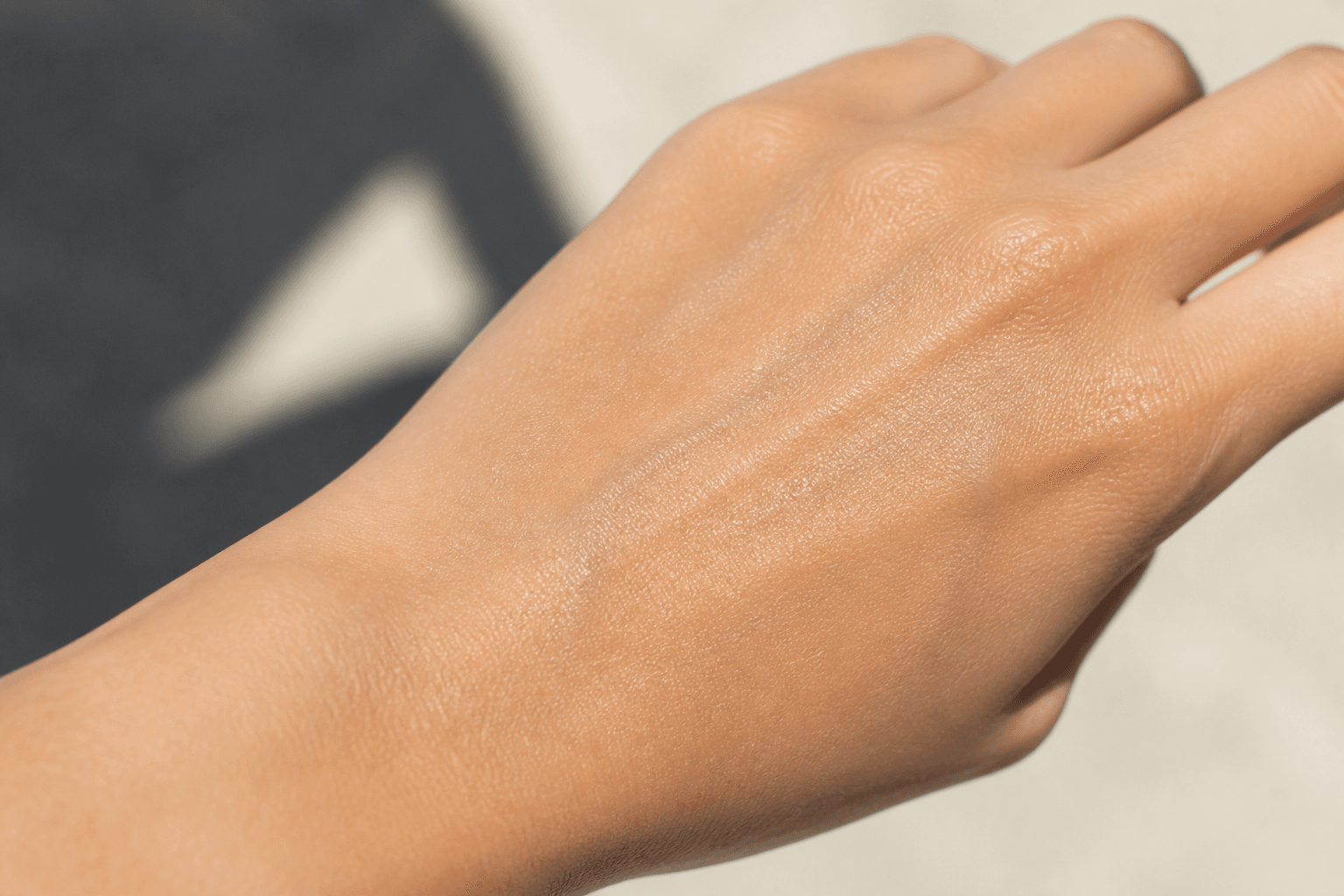
Keratosis pilaris (KP) is the rough, bumpy skin that looks like permanent goosebumps. It usually shows up on the backs of the upper arms, and often on the thighs, buttocks and sometimes the cheeks. The bumps can be skin-coloured, red or brownish, and the skin feels like sandpaper.
It's very common, harmless, and frustrating. It can't be cured, but it can be smoothed out a lot with the right moisturiser. The wrong approach, scrubbing hard, usually makes it look worse.
What causes it
Each bump is a hair follicle plugged with keratin, the protein that forms the outer layer of skin. Instead of shedding normally, the keratin builds up around the opening of the follicle and forms a small, hard plug. Sometimes a curled hair is trapped underneath. The redness around some bumps is mild inflammation.
KP runs in families. It's more common in people with eczema, very dry skin, or ichthyosis vulgaris (an inherited form of dry, scaly skin), and it's linked to variations in the genes that keep the skin barrier working. It tends to be worst in childhood and the teenage years, and often improves with age.
It's usually worse in winter, when the air is dry and indoor heating dries the skin out further, and better in summer.
What actually helps
The treatment has two parts: soften and loosen the keratin plugs, and keep the skin moisturised so they don't build up again. Moisturisers containing a keratolytic (keratin-loosening) ingredient do both at once.
Urea creams
Urea is a natural part of the skin's moisturising system. At around 10%, it's a strong moisturiser. At higher concentrations, around 20% and above, it also softens and loosens built-up keratin. In a small four-week study, people with KP who used a 20% urea cream once a day saw a significant improvement in skin smoothness within a week.
In the UK, 10% urea body lotions are easy to find in pharmacies and supermarkets. Eucerin UreaRepair Plus is a widely sold example. Higher-strength urea creams are usually sold for feet, but many people use them on KP patches. Urea can sting on broken or freshly shaved skin.
Lactic acid
Lactic acid is an AHA that loosens dead skin and also attracts water into the skin. In a three-month trial, people with KP using a 10% lactic acid cream twice a day saw their bumps reduce by an average of 66%. Lactic acid body lotions are less common in UK shops than urea ones, but they're available, especially online. More in what AHAs do.
Salicylic acid
Salicylic acid (BHA) dissolves keratin and works inside the follicle. In the same trial, a 5% salicylic acid cream reduced bumps by an average of 52%. CeraVe SA Smoothing Cream, sold in the UK for rough and bumpy skin, is a familiar salicylic acid body cream. Use salicylic acid creams on limited areas rather than your whole body every day, and avoid them if you're pregnant unless your GP or midwife says it's fine. More on how salicylic acid works.
Retinoids
Prescription retinoid creams can help stubborn KP, but they're often too irritating for large areas of body skin. They're a second-line option to discuss with a GP or dermatologist.
Plain moisturiser
Even without an active ingredient, moisturising daily makes KP feel and look better, because dry skin makes it worse. If your skin is sensitive, a rich, fragrance-free cream with ceramides is a good base. The best ingredients for dry skin covers what to look for.
How to use them
- Shower in lukewarm water, not hot. Hot water strips oils and makes dry skin worse. More in why hot showers damage your skin.
- Use a gentle, non-foaming wash. Avoid harsh soaps on KP areas.
- Pat dry and apply your urea, lactic or salicylic acid cream within a few minutes, while the skin is still slightly damp.
- Use it once or twice a day. Consistency matters more than strength.
- Keep going. KP comes back within weeks if you stop. Once it's under control, many people can drop to a few times a week.
Expect to feel a difference within a couple of weeks and see a visible improvement within one to three months.
What not to do
Don't scrub hard. It's tempting to attack the bumps with a loofah, a sugar scrub or a rough mitt. Aggressive scrubbing irritates the skin, can make redness worse, and doesn't remove the plugs in the follicles. A chemical exfoliant in a moisturiser does more with less damage. If you like physical exfoliation, use a soft cloth gently, a couple of times a week at most.
Don't pick or squeeze the bumps. It can leave marks and scars, especially on darker skin.
Don't dry shave over KP. Shave with a lubricating gel, or let any acid cream sink in fully before shaving, to avoid stinging and ingrown hairs.
Redness and marks
Some people have KP with prominent redness (sometimes called keratosis pilaris rubra), or brown marks that remain after the bumps flatten. Moisturising and acids help the texture but often do less for the colour. Laser and light treatments in a dermatology clinic can reduce the redness. Brown marks fade slowly over months, faster if the area is protected from the sun.
When to see a GP
KP is harmless and usually diagnosed by how it looks. See a GP if:
- The bumps are painful, spreading, or look infected.
- You're not sure it's KP. Folliculitis, acne on the body and some forms of eczema can look similar.
- Over-the-counter creams haven't helped after three months and it bothers you.
- It's on your face, with redness or patches of hair loss in the eyebrows. This can be a less common variant that's worth having checked.
References
Hwang S, Schwartz RA. Keratosis pilaris: a common follicular hyperkeratosis. Cutis. 2008;82(3):177-180. (https://pubmed.ncbi.nlm.nih.gov/18856156/)
Wang JF, Orlow SJ. Keratosis pilaris and its subtypes: associations, new molecular and pharmacologic etiologies, and therapeutic options. Am J Clin Dermatol. 2018;19(5):733-757. (https://pubmed.ncbi.nlm.nih.gov/30043128/)
Kootiratrakarn T, Kampirapap K, Chunhasewee C. Epidermal permeability barrier in the treatment of keratosis pilaris. Dermatol Res Pract. 2015;2015:205012. (https://pubmed.ncbi.nlm.nih.gov/25802513/)
McCormick E, Nussbaum D, Friedman A, et al. Evaluation of a moisturizing cream with 20% urea for keratosis pilaris. J Drugs Dermatol. 2024;23(1):1274-1277. (https://pubmed.ncbi.nlm.nih.gov/38206153/)
FAQs
Can keratosis pilaris be cured?
No, but it can be controlled. Regular use of a urea, lactic acid or salicylic acid moisturiser smooths the skin. It often improves with age.
What is the best cream for keratosis pilaris?
A moisturiser with urea, lactic acid or salicylic acid. In one trial, 10% lactic acid reduced bumps by 66% and 5% salicylic acid by 52% over three months.
Should I exfoliate keratosis pilaris?
Gently, and preferably with a chemical exfoliant in a moisturiser. Hard scrubbing irritates the skin and can make redness worse.
Why is my keratosis pilaris worse in winter?
Cold air and indoor heating dry the skin out, and dry skin makes the keratin build-up worse. Moisturise more often in winter.
Is keratosis pilaris contagious?
No. It's a genetic skin condition, not an infection.