
You may be wondering whether or not you should apply Baby Oil to your face and body, and whether it's any good for your skin. Baby Oil's easy accessibility make it a common choice for parents and skincare enthusiasts alike. What many aren't aware of is what Baby Oil actually is, and what effects it can potentially have on your skin.
What is Baby Oil?
Baby Oil is a mineral oil which is a byproduct from the distillation of gasoline. You did just read that right, it's derived from the same thing you fill your car up with. Being completely synthetic, you might begin to question whether or not application of baby oil is doing your skin any wonders.
The composition of Baby Oil is typically 98% mineral oil and 2% fragrance, commonly used as a selling point. We're all pretty familiar of 'that' baby oil smell. Who doesn't love a good smell when applying skincare products?
Is Baby Oil good for facial and body skin?
Firstly, we'd like to clear up a common misconception about Baby Oil or mineral oil; it doesn't clog pores. Mineral oil scores a 0 on the comedogenic scale, meaning it has close to no effect on your pores. Therefore the likelihood of exacerbating skin conditions such as acne is very low. This is why mineral oil is suitable for most if not all skin types.
Also, while Baby Oil is indeed derived from gasoline, it is subject to stringent quality control standards. This means a pure, mineral oil approved and regulated by local authorities. Studies have displayed no adverse health effects from topical Baby Oil use.
A study conducted by Eugene R. Jolly et al. [1] aimed to determine the effectiveness of Baby Oil as a dermal moisturiser. A sample of 106 females was used, with dry, cracked and inflamed skin. The findings displayed a marked improvement in the skin around elbows, shins, knees and heels after 4 weeks of application.
How baby oil actually works (and how to use it right)
One thing worth understanding: baby oil is an occlusive, not a true moisturiser. It doesn't add water to the skin; it forms a seal on top that stops the water already in your skin from evaporating. That distinction matters for technique. Applied to dry skin, it mostly just sits there feeling greasy. Applied to damp skin, straight out of the shower, it locks that surface moisture in and works genuinely well.
Best uses for baby oil:
- Post-shower body sealing: pat yourself half-dry, apply a thin layer over damp skin, especially shins, elbows and anywhere prone to winter dryness.
- Rough patches: heels, knees and elbows respond well to overnight application.
- Makeup removal in a pinch: mineral oil dissolves even waterproof makeup effectively, though follow it with a proper cleanser to rinse the residue away.
If this sounds familiar, it's essentially the logic behind slugging, which uses petroleum jelly (mineral oil's thicker cousin) the same way.
The verdict: Baby Oil is safe for all skin types and genuinely useful on the body, particularly as a post-shower seal for dry skin. We don't recommend it on the face, not because it clogs pores (it doesn't), but because it leaves a shine, interferes with the absorption of anything applied after it, and complicates makeup. On the face, a proper moisturiser earns its place; on the body, baby oil punches well above its price.
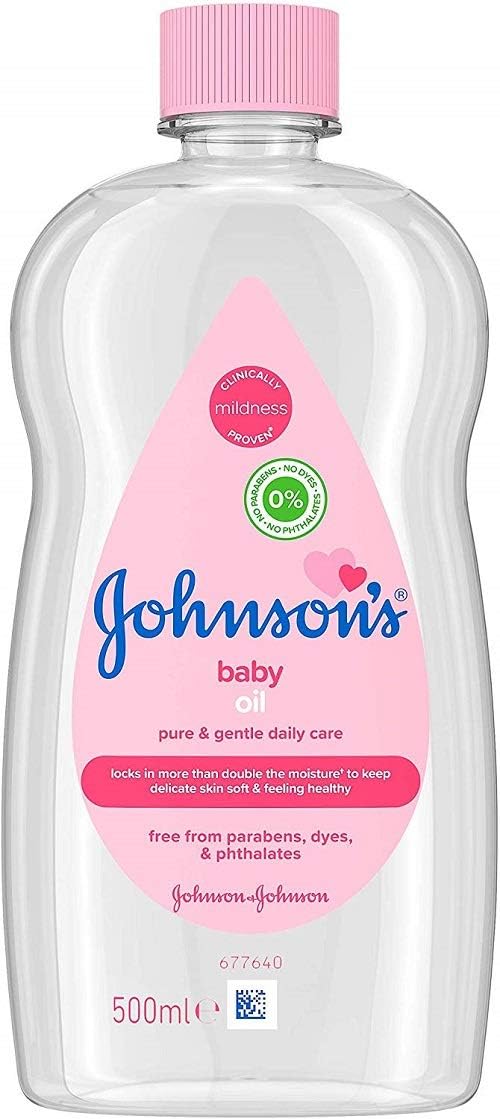
If you're looking to purchase a Baby Oil, there's none more iconic than Johnson's Baby Oil. A pure, gentle formula free from parabens, dyes & phthalates.
References
[1] EUGENE R. JOLLY, M.D., Ph.D. and CHARLES A. SLOUGHFY, "Clinical Evaluation of Baby Oil as a Dermal Moisturizer", J. Soc. Cosmet. Chem., 26, 227-234 (May 1975): http://citeseerx.ist.psu.edu/viewdoc/download?doi=10.1.1.585.6732&rep=rep1&type=pdf