Obviously Skincare
Sunscreen goes on after moisturiser. It's the last step of your skincare, and the first thing under makeup. This applies to both mineral and chemical sunscreens.
The order
- Cleanser
- Toner or essence, if you use one
- Serum
- Eye cream, if you use one
- Moisturiser
- Sunscreen
- Makeup
Why sunscreen goes last
Sunscreen works by forming an even film over the skin. Anything applied on top of it, or mixed into it, can thin that film, break it up, or leave gaps. Putting moisturiser over sunscreen risks all three.
Applying sunscreen last also means your treatment products, serums and moisturiser, are in direct contact with the skin where they need to be, and the sunscreen sits on the surface where it needs to be.
Free toolSunscreen amount calculatorFind out how much sunscreen you should really be using.Open the sunscreen calculator →Is it different for chemical sunscreen?
You may have read that chemical (organic) sunscreens must go on bare skin, before moisturiser, because they need to be "absorbed". That isn't how they work. Chemical filters act in the outermost layer and on the surface of the skin, in a film, the same as mineral filters. Sunscreens are tested and rated as the final layer.
Dermatology organisations give the same advice for both types: sunscreen after moisturiser.
| Mineral sunscreen | Chemical sunscreen | |
|---|---|---|
| Order | After moisturiser | After moisturiser |
| Works immediately? | Yes | Yes, though it's usual to allow time for the film to set |
| Under makeup? | Yes | Yes |
See mineral vs chemical sunscreen.
How to apply it properly
- Let your moisturiser settle for a minute, until skin no longer feels wet. Applying sunscreen onto wet moisturiser dilutes it and causes pilling.
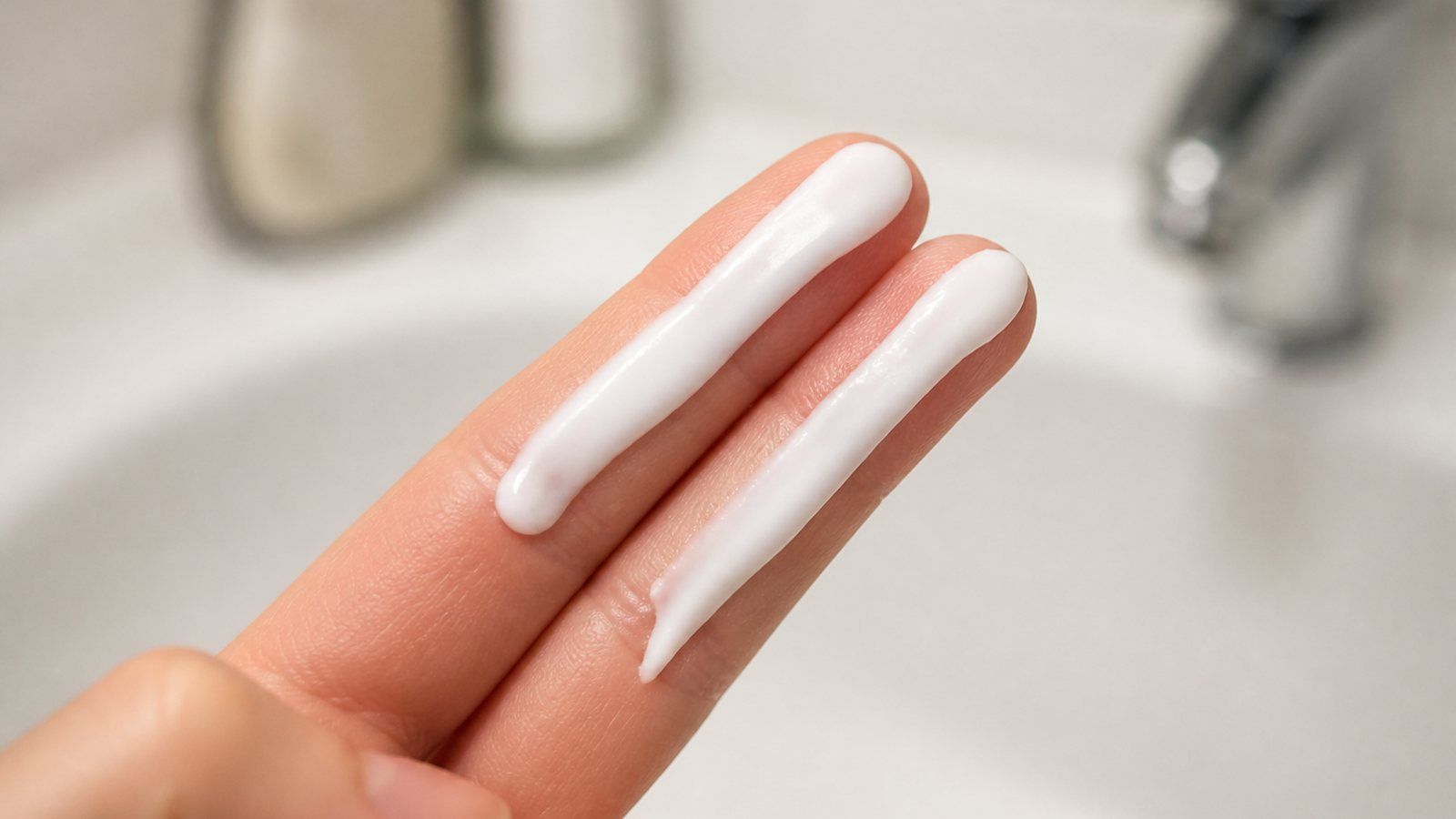
- Use enough. About half a teaspoon for the face and neck, or two full finger-lengths squeezed along your index and middle fingers. Studies show most people apply a quarter to a half of the amount used in SPF testing, which cuts protection substantially.
- Spread it evenly, then leave it. Don't keep rubbing.
- Include the ears, eyelids, hairline, neck and upper chest.
- Wait a few minutes before makeup, and around 15 minutes before going into strong sun.
Work out the amount for your whole body with the sunscreen calculator.
Related guideToner Before or After Moisturiser? The Correct OrderToner goes before moisturiser, straight after cleansing. Why, how acid toners and hydrating toners differ, and whether you need a toner at all.Read the guide →Do you need moisturiser as well?
Not always. Many sunscreens are moisturising.
- Oily skin: a hydrating sunscreen can replace your morning moisturiser.
- Normal or combination skin: try sunscreen alone in summer, moisturiser plus sunscreen in winter.
- Dry skin: use both.
If you skip moisturiser, sunscreen simply goes on after your serum.
Is SPF in a moisturiser enough?
A moisturiser with SPF gives real protection if two conditions are met:
- It's SPF 30 or higher with UVA protection (look for the UVA circle).
- You apply as much of it as you would a sunscreen. This is where it usually fails. People use a small amount of moisturiser, which delivers a fraction of the stated SPF, and they tend to miss areas such as the eyelids and around the eyes.
For an ordinary day mostly indoors, a generous layer of SPF 30 moisturiser is reasonable. For time outdoors, use a dedicated sunscreen.
What about SPF in makeup?
Treat it as a bonus. You'd need far more foundation than anyone wears to reach the SPF on the label. Use sunscreen underneath.
SPF values don't add together. An SPF 30 moisturiser under an SPF 15 foundation doesn't make SPF 45; you get roughly the protection of whichever you applied properly.
Can you mix sunscreen with moisturiser or foundation?
No. Mixing dilutes the filters and disrupts the formula, so you can't know what protection you're left with. Layer them instead.
Where other products go
- Vitamin C serum: before moisturiser.
- Niacinamide, hyaluronic acid: before moisturiser.
- Face oil: before sunscreen, in a small amount, and let it absorb. Oils applied over sunscreen can break up the film. Many people keep oils for the evening.
- Primer: after sunscreen.
- Retinoids and exfoliating acids: in the evening. They make sunscreen more important the next day.
For the full order of a routine, see how to layer skincare and toner before or after moisturiser.
Reapplying
One morning application doesn't last all day.
- Outdoors: reapply every two hours, and after swimming, sweating or towelling.
- Indoors most of the day: the morning layer is usually enough. Top up before going out at lunchtime or for the journey home if the sun is strong.
- Over makeup: use an SPF mist, a cushion compact or a powder sunscreen for convenience. These add less protection than a full layer of lotion, so don't rely on them alone in strong sun.
If your sunscreen pills
Pilling, where product rolls into little balls, is usually a layering problem.
- Use fewer products underneath.
- Let each layer dry.
- Use less of silicone-heavy serums and primers.
- Pat sunscreen on instead of rubbing.
- Try a different sunscreen texture.
At night
No sunscreen at night. Cleanse it off thoroughly in the evening; if it's water-resistant, a double cleanse helps.
For which SPF to choose, see SPF 30 vs SPF 50.
References
Petersen B, Wulf HC. Application of sunscreen: theory and reality. Photodermatol Photoimmunol Photomed. 2014;30(2-3):96-101. (https://pubmed.ncbi.nlm.nih.gov/24313722/)
Hughes MCB, Williams GM, Baker P, Green AC. Sunscreen and prevention of skin aging: a randomized trial. Ann Intern Med. 2013;158(11):781-790. (https://pubmed.ncbi.nlm.nih.gov/23732711/)
FAQs
Does sunscreen go on before or after moisturiser?
After. Sunscreen is the last step of skincare.
Does chemical sunscreen go on before moisturiser?
No. Both chemical and mineral sunscreens go on after moisturiser.
How long should I wait between moisturiser and sunscreen?
About a minute, until your skin no longer feels wet.
Can I skip moisturiser and just use sunscreen?
Yes, if your sunscreen is hydrating enough for your skin.
Is moisturiser with SPF enough?
On indoor days, if it's SPF 30 or higher and you apply plenty. Outdoors, use a separate sunscreen.
Does sunscreen go on before or after makeup?
Before makeup, after moisturiser.