Obviously Skincare

Pore strips are satisfying. You peel one off your nose and see a forest of tiny plugs stuck to it. The problem is that the result lasts days, not weeks, and the dark dots come straight back because nothing has changed about why they formed. Used occasionally, they're harmless for most people. Used as your main blackhead treatment, they're a losing game.
Here's what they actually remove, why the dots return, who should avoid them, and what clears a nose for longer.
Quick verdict
| Question | Answer |
|---|---|
| Do they remove blackheads? | Partly. They pull out the tops of some blackheads and sebaceous filaments. |
| How long do results last? | Usually days to a couple of weeks before the dots are visible again. |
| Do they shrink pores? | No. Pore size is mostly set by genes, oil production and age. |
| Are they safe? | Occasional use is fine for most people. Avoid on irritated, sunburnt or broken skin, or if you use retinoids. |
| What works better? | Salicylic acid a few times a week, with a retinoid for long-term prevention. |
What's actually in those little plugs
Most of what you see on a used strip isn't blackheads at all.
Sebaceous filaments
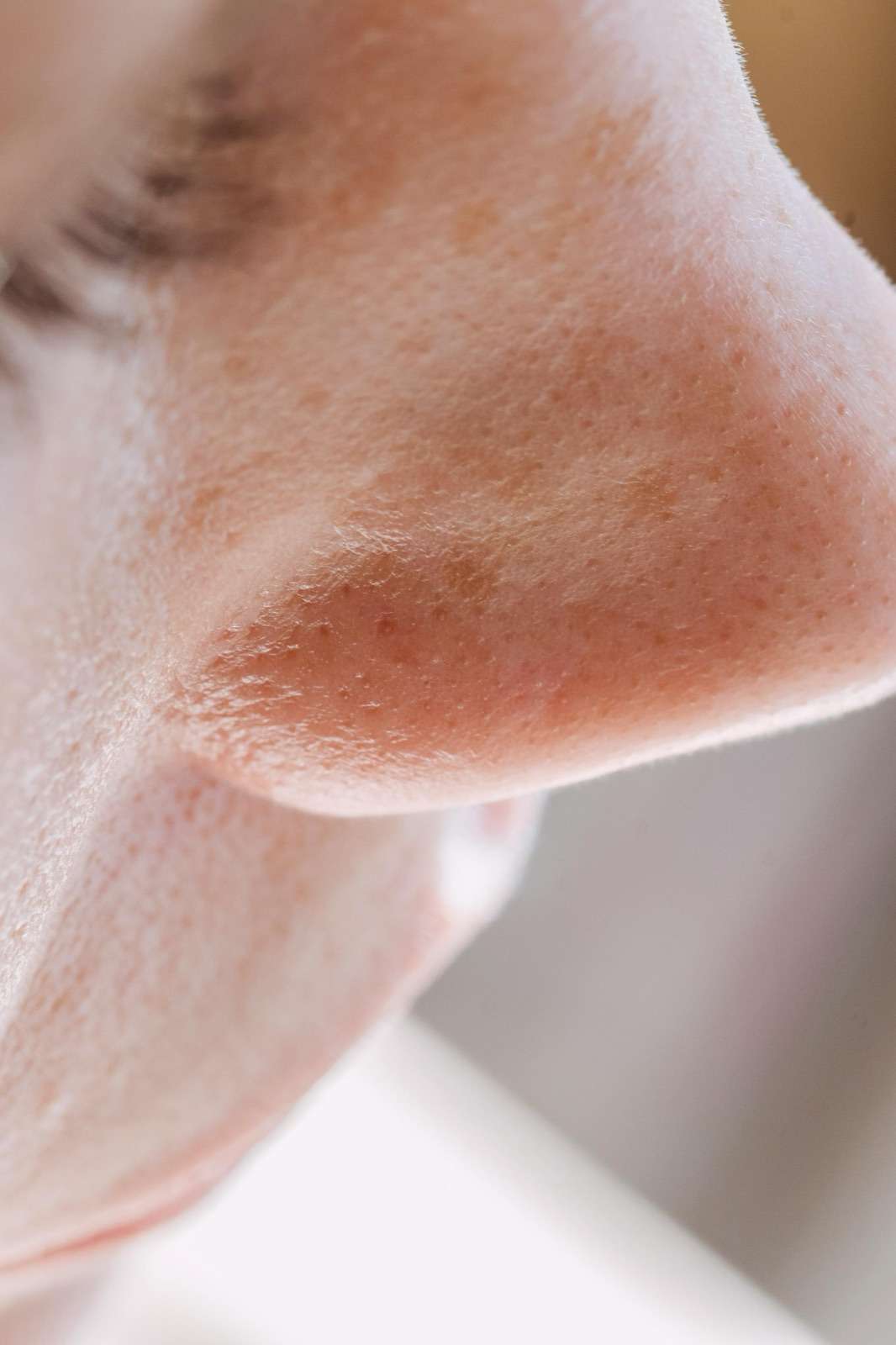
Every pore on your nose has a sebaceous filament: a thin column of oil, dead skin cells and the odd hair that lines the pore and helps carry oil to the surface. They're normal, everyone has them, and they're most visible on the nose, chin and cheeks next to the nose. From a distance they look like small grey or beige dots. Squeeze the skin and they come out as soft, pale threads.
They refill within weeks because your oil glands never stop producing oil. You can make them less visible, but you can't remove them for good, and you don't need to. See sebaceous filaments vs blackheads.
Blackheads
A blackhead (open comedone) is a pore that's become properly blocked with a firm plug of dead skin and oil. Its tip turns dark when the plug is exposed to air, not because it's dirty. Blackheads form because skin cells lining the pore become sticky and shed abnormally, and oil gets trapped behind them. They're the earliest form of acne.
What a strip grabs
The adhesive on a pore strip binds to anything poking above the surface: the tips of filaments and blackheads, dead skin cells and fine facial hair. It rarely removes the whole plug, because the deeper part is anchored in the pore.
| Sebaceous filament | Blackhead | |
|---|---|---|
| Colour | Grey, beige, skin-toned | Dark brown or black tip |
| Feel | Flat, smooth | Can feel slightly raised or rough |
| Pattern | Evenly spaced across nose and cheeks | Scattered, uneven |
| What comes out when squeezed | Soft, pale thread | Firm plug, dark at the top |
| Is it acne? | No, it's normal | Yes, a mild form |
| What a strip does | Removes the top; refills in weeks | Removes the top, sometimes more; reforms |
Why the results don't last
A pore strip treats what you can see, not why it's there. Your oil glands keep producing oil, and the skin lining your pores keeps shedding cells. Within a few days to a couple of weeks, filaments refill and blackheads re-form. That's why people who rely on strips end up using them weekly, sometimes more, and why the dots never go away.
Why they can irritate skin
The adhesive doesn't distinguish between a plug and your skin. Peeling a strip:
- Removes part of the top layer of skin, which can leave the nose red, tight and sensitive for a day or two.
- Can pull at fine hairs, which some people find painful.
- Hits harder on skin that's already compromised. If you use a retinoid, an acid toner, or have eczema, rosacea, sunburn or broken skin, the strip can strip off more than it should and leave raw patches.
If you use them, do it no more than once a week, and only on calm, healthy skin.
Related guideHow to Get Rid of Blackheads on Your Nose (and Keep Them Away)How to clear blackheads on your nose with salicylic acid, retinoids and gentle cleansing, why squeezing and pore strips backfire, and how to tell blackheads from sebaceous filaments.Read the guide →Who should skip pore strips
- Anyone using a retinoid (retinol, tretinoin, adapalene) or a strong acid. The outer layer of skin is thinner and more fragile.
- People with rosacea, eczema or very sensitive skin.
- On sunburnt, broken, peeling or inflamed skin, including active spots.
- If you have visible thread veins on your nose. Pulling and rubbing irritates already sensitive skin.
How to use a pore strip with less irritation
- Cleanse, then wet your nose: the adhesive activates with water.
- Apply the strip firmly and leave it for the time on the pack, usually 10 to 15 minutes, until it's stiff.
- Peel slowly from the edges towards the middle, holding the skin taut.
- Rinse off any residue with lukewarm water.
- Apply a gentle, fragrance-free moisturiser.
- Skip acids and retinoids that night.
Don't squeeze the area afterwards. That's where marks, broken skin and inflammation come from.
What works better for blackheads
These all tackle why pores clog, so the results build and last.
| Treatment | How it helps | How to use it | When you'll see a difference |
|---|---|---|---|
| Salicylic acid (BHA) 0.5 to 2% | Oil-soluble, so it gets inside the pore and loosens the plug | Leave-on toner or serum 2 to 4 evenings a week | 2 to 6 weeks |
| A retinoid (adapalene, retinol) | Normalises how skin cells shed inside the pore, so plugs stop forming | A pea-sized amount 2 to 3 nights a week, building up | 8 to 12 weeks |
| Niacinamide | Reduces visible oiliness | Daily, morning or evening | 4 to 8 weeks |
| Oil cleansing | Loosens soft plugs and filament tips | Massage a cleansing oil over the nose for a minute, then rinse | Immediate, short-lived |
| Clay mask | Absorbs surface oil | Once or twice a week | Immediate, short-lived |
Salicylic acid and retinoids have the strongest evidence. Adapalene 0.1% is available to buy from pharmacies in the UK and is one of the best long-term options for blackheads. See adapalene.
For a full plan, see how to get rid of blackheads on your nose and how to unclog pores.
What about extraction tools, vacuums and charcoal strips?
- Comedone extractors: a dermatologist or trained facialist can safely remove stubborn blackheads. At home, it's easy to press too hard and leave marks.
- Pore vacuums: the suction can cause bruising and broken blood vessels, especially on high settings.
- Charcoal peel-off masks: work like strips across the whole face and are more irritating. See activated charcoal in skincare.
When to see a doctor
If blackheads come with red spots, painful lumps or scarring, it's acne, and prescription treatments work far better than anything you can buy. See a GP or pharmacist, especially if over-the-counter treatments haven't helped after three months.
References
- Cunliffe WJ, Holland DB, Jeremy A. Comedone formation: etiology, clinical presentation, and treatment. Clin Dermatol. 2004;22(5):367-74. (https://pubmed.ncbi.nlm.nih.gov/15556720/)
- Singh Y, Neema S, Bahuguna A, et al. Sebaceous Filaments. Dermatol Pract Concept. 2021;11(1):e2021148. (https://pubmed.ncbi.nlm.nih.gov/33614220/)
- Arif T. Salicylic acid as a peeling agent: a comprehensive review. Clin Cosmet Investig Dermatol. 2015;8:455-61. (https://pubmed.ncbi.nlm.nih.gov/26347269/)
FAQs
Do pore strips work?
Temporarily. They remove the tops of blackheads and sebaceous filaments, which come back within days to weeks.
Are pore strips bad for your skin?
Occasional use on healthy skin is fine for most people. Frequent use, or use on sensitive or retinoid-treated skin, can leave it red, raw and irritated.
Do pore strips make pores bigger?
There's no good evidence they permanently enlarge pores, but they won't make pores smaller either.
How often can you use pore strips?
No more than once a week, and only on calm skin.
Why do my blackheads come back after pore strips?
Because the strip removes only the top of the plug and doesn't change the oil production and skin shedding that cause it.
What's better than pore strips for blackheads?
Salicylic acid used a few times a week, and a retinoid such as adapalene for long-term prevention.