
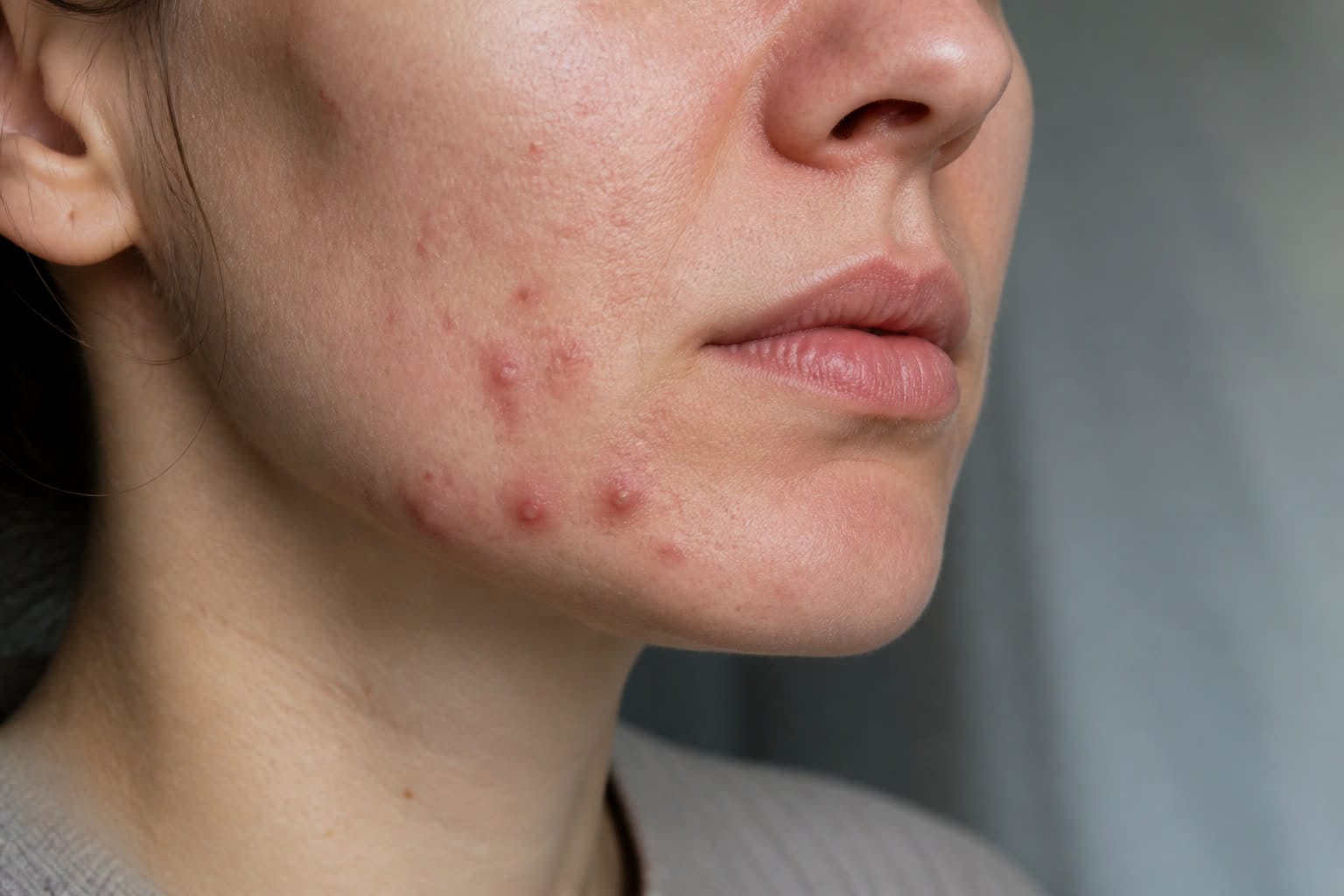
Hormonal acne is the kind that ignores your carefully built routine. It shows up along the jaw, chin and lower cheeks, often as deeper, tender spots rather than surface blackheads, and it tends to flare in the week before a period. If that sounds familiar, the problem usually isn't that you're cleansing wrong. Androgens are telling your oil glands to work overtime, and topical products can only do so much about that.
Here's how to tell if that's what you're dealing with, what is worth using at home, and when a GP is the faster route.
What hormonal acne actually is
Acne is always partly hormonal. Androgens (including testosterone, which everyone has) stimulate sebaceous glands to make more oil. More oil plus dead cells plus C. acnes is the classic recipe for a blocked, inflamed pore.
What people mean by hormonal acne is a pattern: adult-onset or adult-persistent breakouts that cluster on the lower face, worsen cyclically, and don't behave like teenage T-zone congestion. It's especially common in women in their 20s, 30s and 40s. Polycystic ovary syndrome (PCOS), coming off the combined pill, and perimenopause can all make it worse, because they shift the androgen-to-oestrogen balance.
Men get androgen-driven acne too. It just doesn't cycle with a period, so it gets labelled stubborn adult acne instead.
This is not a diagnosis you should self-assign and then ignore. If the spots are cystic, scarring, or coming with irregular periods, excess hair or sudden weight change, see a GP. Skincare is support, not the whole treatment.
How to tell it apart from other acne
A few clues stack up:
- Breakouts sit along the jawline, chin and neck, not mainly on the forehead and nose.
- Spots are often deeper and sorer, sometimes under the skin for days before they come to a head.
- They flare around the same point in your cycle, commonly the week before a period.
- A decent salicylic acid routine helps a bit, then stalls.
If your acne is mostly blackheads across the T-zone, start with our minimal acne routine rather than assuming hormones. If a new retinoid or acid just started and everything flared in the places you already break out, that may be a purge rather than hormonal acne.
What you can do with skincare
Topicals will not switch off androgens. They will unclog pores, calm inflammation and stop as many spots turning into scars.
Azelaic acid is a strong first active here. It's anti-inflammatory, antibacterial and fades the marks hormonal spots leave behind, and it's gentler than most acids. 10% over the counter is a fair start; prescription 15–20% is better if 10% plateaus.
A retinoid is the other high-value topical. Retinol over the counter, or tretinoin / adapalene on prescription, speeds cell turnover so pores don't stay blocked. Expect a few rough weeks. Use it at night, moisturise properly, wear SPF every morning.
Niacinamide helps with oil and the red-brown leftover marks. It will not clear cystic jawline acne on its own.
Keep the rest boring. Gentle cleanser, a non-comedogenic moisturiser, no scrubs, no ten-step routine. Picking makes hormonal spots scar; don't pop them.
Benzoyl peroxide can help inflamed lesions as a short-contact or spot treatment, but it's drying and bleaches towels. It's a tool, not the long-term plan.
What actually moves hormonal acne (and needs a GP)
If the pattern is clearly cyclical or cystic, book a GP. In the UK, useful options they may discuss:
- Combined oral contraceptive pills, particularly ones with anti-androgenic progestogens. These can take three to six months to show a proper effect. Not suitable for everyone (migraine with aura, smoking over 35, clot risk).
- Co-cyprindiol (Dianette and generics) is licensed for acne when topicals haven't worked, but it's not a long-term contraceptive of first choice because of clot risk. GPs use it carefully.
- Oral antibiotics such as lymecycline, usually with a topical retinoid, for a limited course. Antibiotics alone are a stalling tactic.
- Spironolactone is used off-label for women with hormonal acne. More often via dermatology than a first GP appointment, and it needs blood pressure and potassium monitoring.
- Isotretinoin for scarring or severe disease, via dermatology.
None of that is a shopping list. It's why "just add tea tree" fails people with jawline cysts. If spots are scarring, skip the six-month product tour and get referred.
A simple routine while you wait
Morning: gentle cleanser or water, azelaic acid or niacinamide, moisturiser, SPF 30+.
Night: cleanser (double cleanse if you've worn SPF), retinoid or azelaic acid (not stacked until your skin is used to both), moisturiser.
Give that eight to twelve weeks before judging it. Hormonal acne is slow. If it's worsening, scarring, or you have PCOS-type symptoms, don't wait out the twelve weeks in silence.
The verdict
Hormonal acne is real, it's mostly an androgen problem, and no serum will out-shout a hormone shift. A tight topical routine (retinoid, azelaic acid, SPF, leave the spots alone) is worth doing. Persistent jawline cysts, scarring, or a flare that tracks your cycle belong with a GP, not another cleanser.
References
Zaenglein AL, Pathy AL, Schlosser BJ, et al. Guidelines of care for the management of acne vulgaris. J Am Acad Dermatol. 2016;74(5):945-973.e33.
Franks S. Polycystic ovary syndrome. N Engl J Med. 1995;333(13):853-861.
Layton AM, Eady EA, Whitehouse H, et al. Oral spironolactone for acne vulgaris in adult females: a hybrid systematic review. Am J Clin Dermatol. 2017;18(2):169-191.
FAQs
What does hormonal acne look like?
Typically deeper, tender spots along the jaw, chin and lower cheeks, often flaring before a period. Blackheads across the nose are more likely regular congestion than a hormone-specific pattern.
Can skincare cure hormonal acne?
It can reduce clogged pores, redness and leftover marks. It cannot switch off the androgen signal driving the oil glands. That's why some people need the pill, spironolactone or isotretinoin on top of a good routine.
What is the best ingredient for hormonal acne?
A retinoid and/or azelaic acid are the two strongest over-the-counter starting points. For cystic or scarring disease, the "best ingredient" is usually a prescription, not another serum.
Does hormonal acne go away after your period?
Often the flare calms after the period starts, then returns the next cycle. That loop is a reason to treat the hormone side, not just spot-treat each month.
When should I see a GP about hormonal acne?
If spots are cystic or scarring, if over-the-counter routines have failed for a few months, or if acne comes with irregular periods, excess hair or other PCOS symptoms. Earlier is better once scarring has started.