
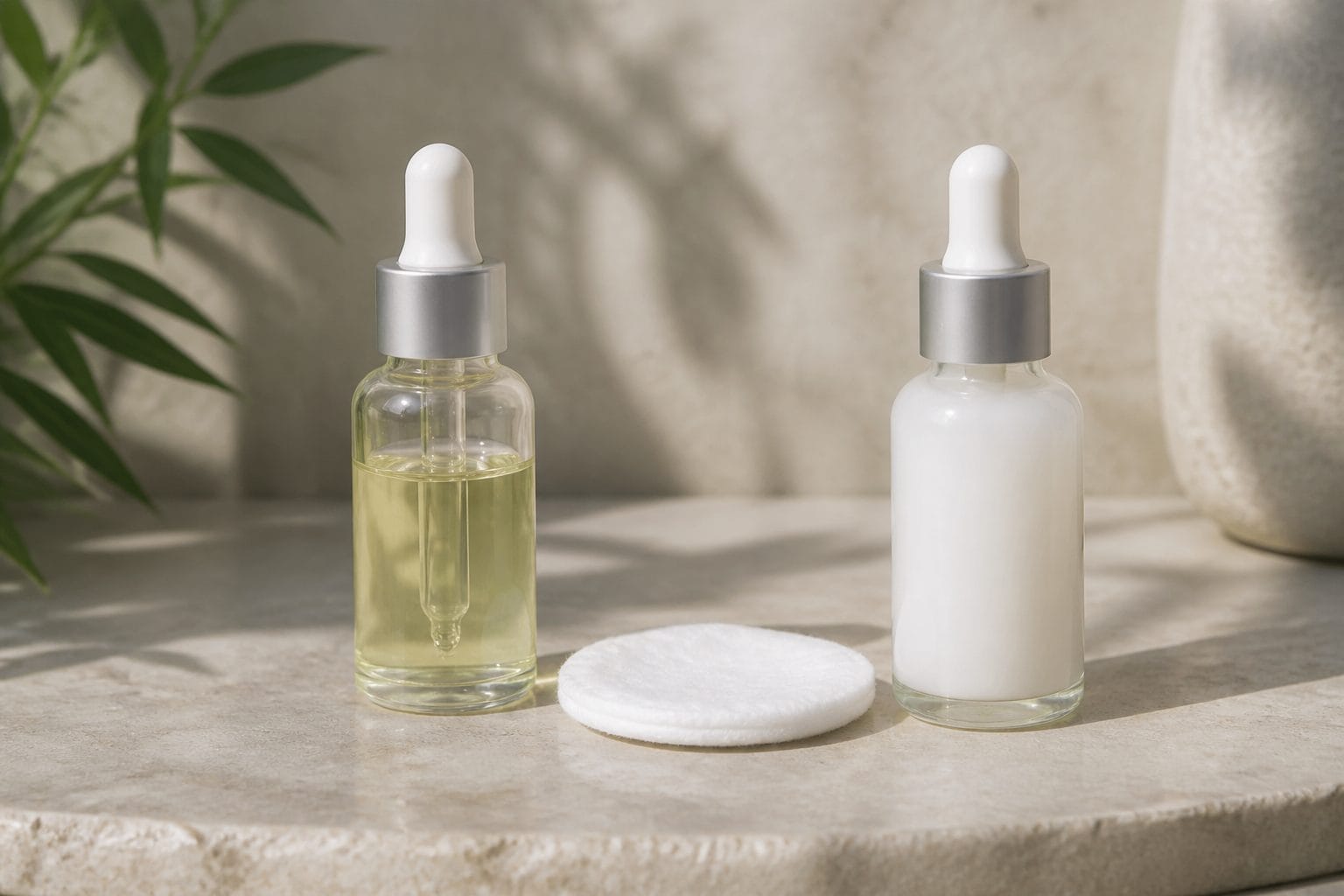
Niacinamide and azelaic acid can be used together. There is no known chemical conflict that makes either ingredient ineffective, and the pairing makes practical sense for oily skin, acne, redness and the marks breakouts leave behind.
That does not mean everybody needs both, or that stacking them produces results twice as fast. I am sceptical of routines that turn every compatible ingredient into a compulsory layer. Start with the concern you are treating, choose sensible concentrations and make sure the products behave together on your face.
For the individual background, read my guides to what azelaic acid does and how niacinamide works. Here I am concentrating on the combination.
Why the pairing makes sense
These ingredients overlap, but they do not work in exactly the same way.
Niacinamide is a form of vitamin B3. Topically, it supports production of barrier lipids, can reduce the look of redness and may modestly reduce sebum output. For uneven colour, it interferes with transfer of pigment-containing melanosomes into skin cells. It is usually easy to use daily, although high-strength 10% serums can sting some faces.
Azelaic acid is a dicarboxylic acid with anti-inflammatory, antimicrobial and keratinisation-normalising effects. It is useful for inflamed acne and rosacea-type bumps. It also inhibits tyrosinase, an enzyme involved in melanin production, which is why it is used for post-inflammatory hyperpigmentation.
Put together, they address several parts of the same problem:
- Oil and congestion: niacinamide may reduce surface oil, while azelaic acid helps normalise the cells that can block pores.
- Inflamed spots and redness: azelaic acid has the more direct evidence here; niacinamide provides gentle supporting care.
- Post-acne marks: the ingredients affect pigment through different pathways.
- Barrier tolerance: niacinamide may help the barrier cope with treatment, although it cannot cancel irritation caused by using too much azelaic acid.
This is most compelling if you have blemishes and the red or brown marks that remain. My guides to reducing dark spots and fixing uneven skin tone cover other causes and treatment options.
How to layer niacinamide and azelaic acid
For a typical watery niacinamide serum and thick azelaic acid cream or suspension, use this order:
- Cleanse and pat the face dry.
- Apply two or three drops of niacinamide serum.
- Let it settle until the surface is no longer wet.
- Smooth a pea-sized amount of azelaic acid over the whole face or treatment area.
- Follow with moisturiser if needed.
- In the morning, finish with broad-spectrum SPF 30 or higher.
This follows the practical thin-to-thick principle in my skincare layering guide. It is about forming an even film, not racing ingredients through imaginary skin “windows”.
The Ordinary Azelaic Acid Suspension 10% is unusually thick and silicone-heavy. Too much product, rubbing repeated layers or putting it over a tacky serum can make it roll into little flakes. My full review of The Ordinary Azelaic Acid 10% deals with that texture in detail.
If your azelaic acid is a lighter gel and your niacinamide lives in a cream, use the gel first. Product texture is more useful than treating ingredient names as a rigid order.
The easier option: split morning and night
You do not have to layer them. In fact, I often prefer:
Morning: gentle cleanse, niacinamide, moisturiser, sunscreen.
Evening: cleanse, azelaic acid, moisturiser.
Splitting the pair lowers the chance of pilling and makes it obvious which product is causing irritation. It also suits people who dislike several layers beneath sunscreen. Reversing the split is fine; azelaic acid is not known to be meaningfully photosensitising, though sunscreen remains essential when treating pigmentation.
Another option is alternate nights. That is sensible for very sensitive skin or a routine that already includes a retinoid. Compatibility on paper does not determine what your barrier can tolerate in practice.
What strength and frequency should you use?
Niacinamide does not need to be 10% to work. Products in the 2–5% range can support the barrier and pigmentation with less chance of flushing or tackiness. The Ordinary Niacinamide 10% + Zinc 1% is affordable and popular, but my honest review of that serum explains why more is not always better.
Over-the-counter azelaic acid is commonly 10%. Prescription products available in the UK include 15% gel and 20% cream, and have stronger clinical evidence for acne and rosacea. Do not try to mimic a prescription by applying a 10% product twice as thick.
If both products are new:
- Patch test each separately.
- Introduce niacinamide once daily for several days.
- Add azelaic acid every other evening.
- Increase azelaic acid to nightly only if skin remains comfortable.
- Change one variable at a time.
A brief mild tingle from azelaic acid can happen. Persistent burning, swelling, itch or scaling is a reason to stop, simplify the routine and reassess.
Can they cause purging?
Niacinamide should not cause a true purge because it does not meaningfully accelerate exfoliation. Azelaic acid affects abnormal keratinisation and some people report early breakouts, but “purging” is overused online. New spots across unusual areas, itching or a rash are more suggestive of irritation or an unsuitable formula.
Do not keep using a painful product for six weeks because social media says the reaction proves it is working. Stop and let the skin settle.
What else can you use with them?
Both ingredients fit with a basic cleanser, moisturiser and sunscreen. Hyaluronic acid and ceramides are also straightforward.
Retinoids, salicylic acid, benzoyl peroxide and strong vitamin C can each be used somewhere in the wider routine, but adding several at once raises irritation risk. If you already use a prescription acne treatment, keep the rest boring and follow the prescriber's advice. My guide to ingredients you should not mix casually is mainly about cumulative irritation, not dramatic chemical reactions in the bottle.
Pregnancy advice deserves more than a blanket online answer. Azelaic acid and niacinamide are generally regarded as acceptable topical options, but discuss a new treatment with your GP, midwife or pharmacist.
Who is this combination best for?
I would consider both if you have oily or combination skin, mild inflammatory acne, rosacea-prone redness, or post-acne dark marks. Azelaic acid is doing most of the treatment work for rosacea; niacinamide is support.
Skip the pairing for now if your barrier is raw, every product stings or you are already juggling several actives. One well-tolerated product used consistently is better than two abandoned after a fortnight.
References
Hakozaki T, Minwalla L, Zhuang J, et al. The effect of niacinamide on reducing cutaneous pigmentation and suppression of melanosome transfer. Br J Dermatol. 2002;147(1):20-31. (https://pubmed.ncbi.nlm.nih.gov/12100673/)
Sieber MA, Hegel JKE. Azelaic acid: properties and mode of action. Skin Pharmacol Physiol. 2014;27 Suppl 1:9-17. (https://pubmed.ncbi.nlm.nih.gov/24993837/)
Thiboutot D, Thieroff-Ekerdt R, Graupe K. Efficacy and safety of azelaic acid (15%) gel as a new treatment for papulopustular rosacea. J Am Acad Dermatol. 2003;48(6):836-845. (https://pubmed.ncbi.nlm.nih.gov/12789142/)
FAQs
Can I use niacinamide and azelaic acid at the same time?
Yes. Apply a watery niacinamide serum first, let it settle, then use a thin layer of azelaic acid and moisturiser. If the products pill or your skin is sensitive, split them between morning and evening.
Which goes first, niacinamide or azelaic acid?
Usually niacinamide first because its serum is thinner and azelaic acid creams are thicker. If your azelaic acid is a light gel and niacinamide is in a cream, follow texture and put the gel first.
Is the combination good for acne and dark spots?
It can be. Azelaic acid targets inflamed acne and melanin production, while niacinamide may help oil, barrier function and pigment transfer. Expect gradual improvement over roughly eight to twelve weeks, not an overnight change.
Can I use both every day?
Many people can after a gradual introduction. Begin azelaic acid every other night and niacinamide once daily. Reduce frequency if you develop persistent burning, redness or flaking.
Do niacinamide and azelaic acid cancel each other out?
No. The idea that ordinary skincare pH differences make this pair ineffective is not supported by good evidence. The real issues are irritation, excessive concentration and products pilling when too much is layered.