
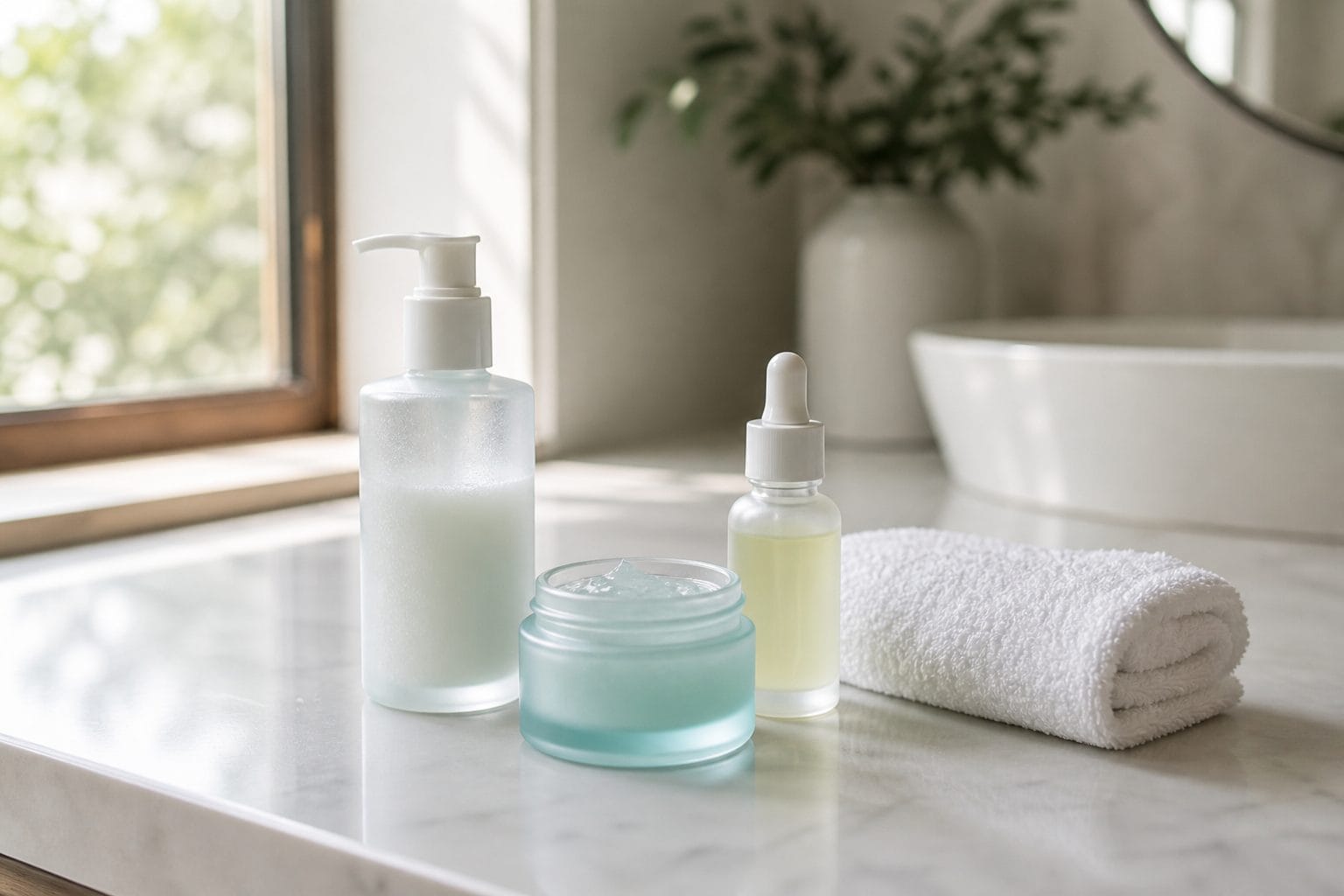
The best oily skin care routine is not the one that removes every trace of oil. That tight, matte feeling may be satisfying for ten minutes, but it usually means you've stripped away water and barrier lipids as well as excess sebum. The result can be a shiny face that somehow also feels uncomfortable.
I've had far better results treating oily skin as skin that needs balance, not punishment. A gentle cleanser, one useful treatment, a light moisturiser and sunscreen cover most of the job. Here is the complete morning and evening routine I recommend, without the three toners and emergency clay mask.
What an oily skin care routine needs to do
Sebum is not dirt. It lubricates the skin and supports its barrier; oily skin simply produces more of it. Genetics, hormones, climate and some medications can all affect that output. Skincare can reduce surface shine and keep pores clearer, but it cannot permanently switch off sebaceous glands.
First, make sure oil is actually the issue. Our skin type quiz is useful if you're unsure. If your whole face becomes shiny fairly quickly after washing, oily is likely. If only your forehead and nose shine while your cheeks feel dry, you may have combination skin.
There is another common complication: dehydration. Dry skin lacks oil; dehydrated skin lacks water. Oily skin can be dehydrated after harsh cleansing, too many acids, heating or cold weather. Tightness, fine crepey lines and lots of shine at once are clues. Trying to degrease that face harder only deepens the problem.
Best oily skin care routine in the morning
1. Cleanse gently
Use a low-foaming gel cleanser with lukewarm water for about 30 seconds. CeraVe Foaming Cleanser and La Roche-Posay Toleriane Purifying Foaming Cleanser are sensible UK options. A cleanser should remove overnight oil without making your face squeak. I've compared more textures in the guide to choosing the best cleanser for oily skin.
If your face wakes up comfortable rather than greasy, rinsing with water is also legitimate. Washing because a routine chart says so is not evidence that your skin needs washing.
2. Add niacinamide, if it helps
A 4–5% niacinamide serum can support the barrier and modestly reduce the look of oiliness over time. It is not an instant sebum shut-off valve. Ten per cent formulas, including The Ordinary Niacinamide 10% + Zinc 1%, suit some people but can sting or pill on others.
I would start lower if you're reactive, or use a moisturiser that already contains it. Our guide to what niacinamide does explains the ingredient in more depth, while the best serums for oily skin includes non-niacinamide options too.
3. Use a lightweight moisturiser
Yes, oily skin still needs moisturiser. Water escapes from oily skin just as it does from any other skin type, especially after cleansing. A light lotion or gel supplies humectants and barrier support without a heavy finish. Skipping it can leave skin tight, irritated and harder to tolerate acne treatments.
Look for glycerin, hyaluronic acid, ceramides or panthenol. CeraVe Facial Moisturising Lotion, Cetaphil Daily Hydrating Moisturiser and La Roche-Posay Toleriane Sensitive Fluide are straightforward choices. The point is comfortable skin, not adding a ceremonial layer; see my oily-skin moisturiser picks for more.
4. Finish with SPF 30 or 50
Use a broad-spectrum sunscreen every morning, applying roughly two finger lengths for face and neck. Gel-fluid and oil-control formulas tend to sit better than rich creams. La Roche-Posay Anthelios UVMune 400 Oil Control Fluid is widely available, but the best SPF for oily skin is ultimately one you'll apply generously rather than ration.
Do not rely on SPF in foundation. Most people apply nowhere near enough makeup to reach the labelled protection.
Best oily skin care routine at night
1. Remove sunscreen and makeup
If you've worn water-resistant SPF or makeup, start with a cleansing oil, balm or micellar water and follow with your gentle gel cleanser. My double cleansing guide covers the method. Two cleanses are useful for removal, but washing twice with a harsh foaming cleanser is just stripping.
On a bare-face day, one cleanse is enough.
2. Use salicylic acid two or three nights a week
Salicylic acid is oil-soluble, so it can move into the oily material within pores and help loosen the dead-cell build-up behind blackheads and small bumps. A leave-on 1–2% product is more useful for persistent congestion than an acid cleanser that is rinsed away quickly.
Start twice weekly on dry skin, then move to three nights if there is no lasting sting, redness or flaking. Paula's Choice 2% BHA Liquid and The Ordinary Salicylic Acid 2% Solution are established options. Read the fuller salicylic acid guide before combining it with other actives.
More is not better. Daily acids, an acid cleanser and a scrub can turn manageable oil into inflamed, dehydrated skin. If clogged pores are your main concern, follow this targeted guide on how to unclog pores.
3. Moisturise again
Use the same light moisturiser as morning, or a slightly richer lotion if your treatment leaves you tight. This is not "feeding" oil or acne. Proper moisturising helps you tolerate salicylic acid consistently, and consistency beats an aggressive routine abandoned after a fortnight.
If even bland products sting, pause the acids and follow a skin barrier repair routine until your face feels normal.
What to avoid in an oily skin routine
- Harsh cleansing morning and night. Tightness is a warning, not proof of cleanliness.
- Alcohol-heavy astringent toners. Alcohol denat high on the list can give a temporary matte finish while increasing dryness and irritation.
- Daily scrubs or cleansing brushes. They do not reach into pores, and friction adds inflammation.
- Layering every oil-control ingredient. Niacinamide, salicylic acid, retinoids and clay all at once make it impossible to identify what is helping.
- Using clay masks as treatment. They absorb surface oil for a few hours. Fine before an event, irrelevant to long-term sebum production.
Give the basic routine six to eight weeks. Oil may look less obvious sooner, but clogged pores and blemishes change with skin cycles, not overnight. Painful, scarring or persistent acne deserves a GP or dermatologist rather than another stronger serum. Jawline spots that flare with a cycle are often hormonal acne, which topicals only partly treat.
References
Youn SW. The role of facial sebum secretion in acne pathogenesis: facts and controversies. Clin Dermatol. 2010;28(1):8-11. (https://pubmed.ncbi.nlm.nih.gov/20082943/)
Arif T. Salicylic acid as a peeling agent: a comprehensive review. Clin Cosmet Investig Dermatol. 2015;8:455-461. (https://www.ncbi.nlm.nih.gov/pmc/articles/PMC4554394/)
Draelos ZD, Matsubara A, Smiles K. The effect of 2% niacinamide on facial sebum production. J Cosmet Laser Ther. 2006;8(2):96-101. (https://pubmed.ncbi.nlm.nih.gov/16766489/)
Hughes MCB, Williams GM, Baker P, Green AC. Sunscreen and prevention of skin aging: a randomized trial. Ann Intern Med. 2013;158(11):781-790. (https://pubmed.ncbi.nlm.nih.gov/23732711/)
FAQs
What is the best oily skin care routine?
In the morning, gently cleanse, use an optional niacinamide serum, apply a lightweight moisturiser and finish with SPF 30 or 50. At night, remove sunscreen or makeup, cleanse, use salicylic acid two or three times weekly, then moisturise.
Should oily skin use moisturiser every day?
Yes. Oily skin can still lose water and develop a damaged barrier. Choose a light, fragrance-free gel or lotion rather than skipping moisturiser. If your skin feels greasy after it, try a smaller amount or a lighter formula.
Can oily skin also be dehydrated?
Absolutely. Oil is sebum; hydration is water. Harsh cleansing and over-exfoliation can leave a face tight and water-depleted while it remains shiny. Reduce stripping products and use humectants plus a light moisturiser.
How often should oily skin use salicylic acid?
Start twice a week, then increase to three times if your skin stays comfortable. Some people tolerate daily use, but it is not automatically more effective. Scale back if you develop stinging, redness or flakes.
How long does an oily skin routine take to work?
Allow six to eight weeks to judge congestion and blemishes. Surface shine may improve earlier. Change only one product at a time, or you will not know what worked or what caused irritation.