
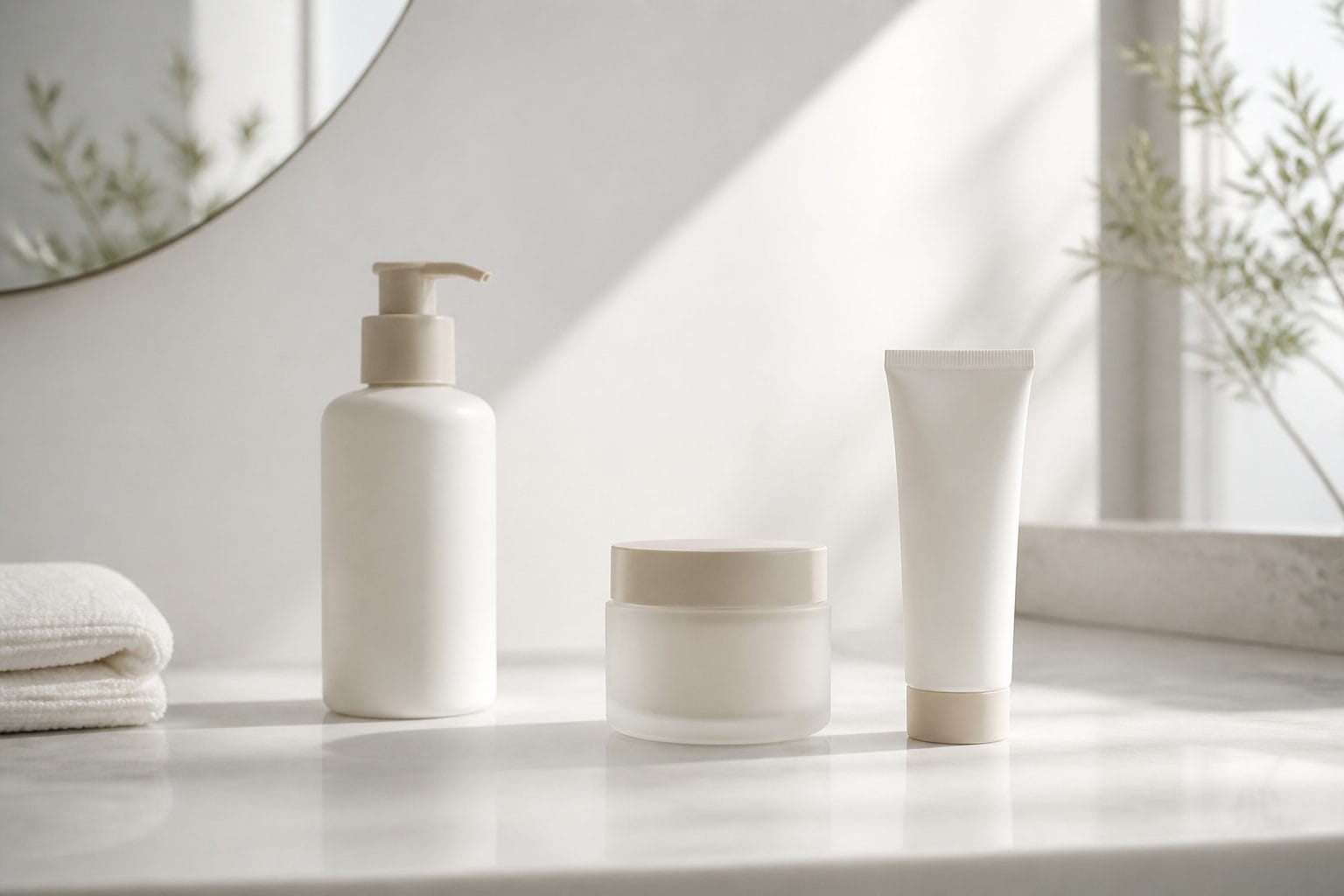
A minimalist skincare routine is four steps: cleanse, moisturise, SPF in the morning, and one targeted treatment if you need it. That's the whole answer. Everything else on your shelf is either a nice-to-have or actively working against you.
I know that sounds reductive when the industry is selling ten-step routines and your bathroom cabinet is full of toners, essences, ampoules and three half-used exfoliants. But I've watched more skin improve from people cutting products than from people adding them, and there's a good reason for that. Here's how to strip your routine back to the steps that actually matter, and why your skin will thank you for it.
Why less is more in skincare
Three things go wrong when routines get bloated, and they compound each other.
Irritation stacks up quietly. Every product you apply is another set of ingredients your skin has to tolerate: fragrances, preservatives, essential oils and actives. Layer six products twice a day and you're exposing your skin to dozens of potential irritants, many of which overlap. Exfoliating toner plus acid serum plus retinol at night is how people end up with stinging, flaky, reactive skin and a damaged barrier. Mild cleansing and fewer ingredient exposures are genuinely better tolerated, and the research on cleanser-induced barrier damage backs this up.
Cost scales with clutter, not results. A ten-step routine can easily run to hundreds of pounds a year more than a four-step one, and most of that extra spend goes on products doing a job another product already does. Two hydrating serums don't hydrate twice as well.
Adherence is the step nobody talks about. The best routine is the one you'll actually do every single day, including when you're exhausted at 11pm. Dermatology research on topical treatments consistently finds that adherence is poor and that simpler regimens get followed more reliably. A four-step routine done 365 days a year beats a ten-step routine done three times a week, every time.
The 4-step minimalist routine
Whatever your skin type, the daily core is the same. If you're starting completely from scratch, our guide on what to do if you have no skincare routine walks through this from zero.
1. Cleanse
Once in the evening is essential; morning can be a splash of water or a light cleanse depending on how oily you are. The goal is removing sunscreen, makeup, sebum and the day's grime without stripping your skin. If your face feels tight or squeaky after washing, your cleanser is too harsh, full stop. A gentle, low-foam, fragrance-free cleanser suits almost everyone; Cetaphil's Gentle Skin Cleanser has been my default recommendation for years because it's cheap, boring and effective, which is exactly what a cleanser should be.
2. Moisturise
Morning and night, regardless of skin type. Yes, even oily skin. A moisturiser's job is to reduce water loss and keep the barrier functioning, and a functioning barrier is what makes every other product work. Look for ceramides, glycerin or hyaluronic acid on the label rather than marketing claims on the front. If your skin runs dry, our best moisturisers for dry skin round-up has specific picks.
3. SPF every morning
This is the single highest-impact product in any routine. UV exposure drives the majority of visible skin ageing, and a randomised trial in Australian adults found daily sunscreen use measurably slowed skin ageing compared with discretionary use. A broad-spectrum SPF 30 or higher, applied every morning you'll be outdoors, does more for your skin long-term than every serum combined. We've covered why SPF is non-negotiable in depth.
4. One targeted treatment (optional)
This is where minimalism gets personal. Pick your single biggest skin concern and choose one treatment for it: salicylic acid for clogged pores, niacinamide for oiliness and uneven tone, retinol for fine lines, vitamin C for dullness. One. Not five. More on this below.
Weekly extras like a face mask or exfoliating once or twice are fine if you enjoy them, but they're the dessert, not the meal.
Declutter first: the PAO rule
Before you build the routine, clear the shelf. Two rules make this easy.
Check the period-after-opening symbol. Every cosmetic sold in the UK carries a small open-jar icon with a number like "6M" or "12M". That's how long the product is safe and effective after first opening. If you cracked open that serum eighteen months ago and it says 6M, bin it. Expired products lose potency at best; at worst they've grown bacteria, and preservative systems don't last forever.
If you haven't used it in three months, you don't need it. Sunk cost is why we all keep half-empty bottles. The money is spent either way; the only question is whether the product earns shelf space. Almost nothing that's sat untouched for a season will suddenly become essential.
What you're left with should be a small set of products you reach for daily. That's the collection worth having.
Why toner is usually redundant
Toner is the product I tell people to cut first, and the logic is straightforward.
If you're using toner to "finish cleansing", your cleanser isn't doing its job. Fix the cleanser rather than adding a step to mop up after it. The days of toners existing to rebalance skin after harsh alkaline soaps are long gone; modern cleansers are pH-balanced.
If you're using toner as a treatment, read the label. Many contain the same actives you'd find in a serum, like glycolic or salicylic acid, usually at lower, less effective concentrations. And if you tone with an acid toner then layer an acid serum on top, you're double-dosing the same active, which is a fast route to irritation. A dedicated serum almost always beats the toner version of the same ingredient.
There are decent hydrating toners, and if yours genuinely earns its place you can keep it; we've covered whether toner goes before or after moisturiser if you're keeping one. But for most people it's a step that costs money and adds nothing.
Tailoring the routine for oily skin
The core four steps stay the same; the textures and the treatment change.
Cleanse twice a day, but resist the urge to go harsh. Stripping oily skin triggers more oil production, not less. Gel cleansers work well; squeaky clean is a warning sign, not a goal.
Moisturise with a light gel or lotion rather than skipping the step. Dehydrated oily skin overproduces sebum to compensate.
Your one treatment should almost certainly be salicylic acid. It's oil-soluble, so it exfoliates inside the pore where blackheads and congestion actually form. The Ordinary's Salicylic Acid 2% Solution is cheap and effective; two to three evenings a week is plenty to start.
Skip the pore strips. They're satisfying and useless in equal measure, and repeated use irritates the nose area. We've explained why pore strips aren't worth it if you need convincing.
Tailoring the routine for dry skin
For dry, flaky or tight skin, the priority flips: protect the oils you have and put moisture back in.
Cleanse once a day in the evening with a cream or lotion cleanser, non-foaming and fragrance-free. Morning can just be lukewarm water.
Moisturise generously, morning and night, with ceramides high on the ingredient list. This is the most important step for dry skin and the one place I'd spend a little more.
Exfoliate less than you think. Once a week maximum, with something mild like lactic acid. Strong acids on already-dry skin mean more flaking, not less. If you're seeing persistent tightness or stinging, you may already be overdoing it; here are the signs you're over-exfoliating.
Your one treatment might simply be a hyaluronic acid serum under moisturiser, or nothing at all. Dry skin often needs fewer actives, not more.
The one-active-at-a-time rule
This is the rule that makes minimalism work, so it gets its own section.
Introduce one new active ingredient at a time, use it consistently for six to eight weeks, and only then judge whether it's earning its place. Skin cell turnover takes roughly a month, so anything judged in a fortnight hasn't had a fair trial.
Layering multiple new actives at once fails on three fronts. You can't tell what's working, so you end up superstitiously keeping everything. You multiply the odds of irritation, and when it happens you won't know the culprit. And some combinations actively conflict; retinol layered with strong acids is the classic barrier-wrecker, and we keep a full list of skincare ingredients you should never mix.
One concern, one treatment, one honest trial. If it works, it stays. If it doesn't, it goes, and you try the next candidate. That's the entire system.
Final word
A cleanser, a moisturiser, a sunscreen and one well-chosen treatment will outperform a cluttered shelf every time, because you'll actually use them, your skin will actually tolerate them, and you'll actually know what's working. Minimalism in skincare isn't deprivation; it's just refusing to pay for redundancy.
References
Hughes MC, Williams GM, Baker P, Green AC. Sunscreen and prevention of skin aging: a randomized trial. Ann Intern Med. 2013;158(11):781-790.
Ananthapadmanabhan KP, Moore DJ, Subramanyan K, Misra M, Meyer F. Cleansing without compromise: the impact of cleansers on the skin barrier and the technology of mild cleansing. Dermatol Ther. 2004;17 Suppl 1:16-25.
Feldman SR, Camacho FT, Krejci-Manwaring J, Carroll CL, Balkrishnan R. Adherence to topical therapy increases around the time of office visits. J Am Acad Dermatol. 2007;57(1):81-83.
Draelos ZD. The science behind skin care: Moisturizers. J Cosmet Dermatol. 2018;17(2):138-144.
Frequently Asked Questions
What is a minimalist skincare routine?
A minimalist routine is the smallest set of products that keeps your skin healthy: a gentle cleanser, a moisturiser, daily SPF, and at most one targeted treatment for your main concern. Everything beyond that is optional.
Do I really need a toner?
Usually not. Modern cleansers are pH-balanced, and treatment toners tend to be weaker versions of serums you could use instead. Unless a specific hydrating toner genuinely earns its place, it's the first product to cut.
Can a simple routine work for acne or oily skin?
Yes, and it often works better. Gentle cleansing, a light moisturiser, SPF and salicylic acid two to three times a week covers the fundamentals without the stripping and irritation that make oiliness worse.
How long should I trial a new product before judging it?
Six to eight weeks of consistent use. Skin cell turnover takes around a month, so anything judged sooner hasn't had a fair chance. Introduce only one new product at a time so you know what's responsible for any change.
Is a 10-step skincare routine bad for your skin?
Not inherently, but it raises the odds of irritation from overlapping actives, costs far more, and is much harder to stick to daily. Most people get better results from four steps done consistently than ten steps done sporadically. Skinimalism is still one of the skincare trends worth following in 2026.